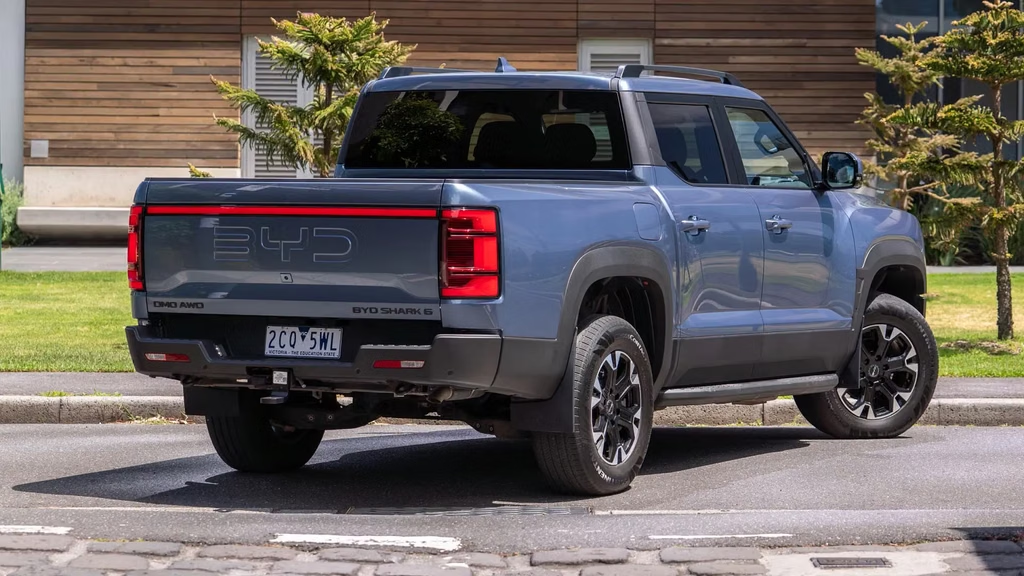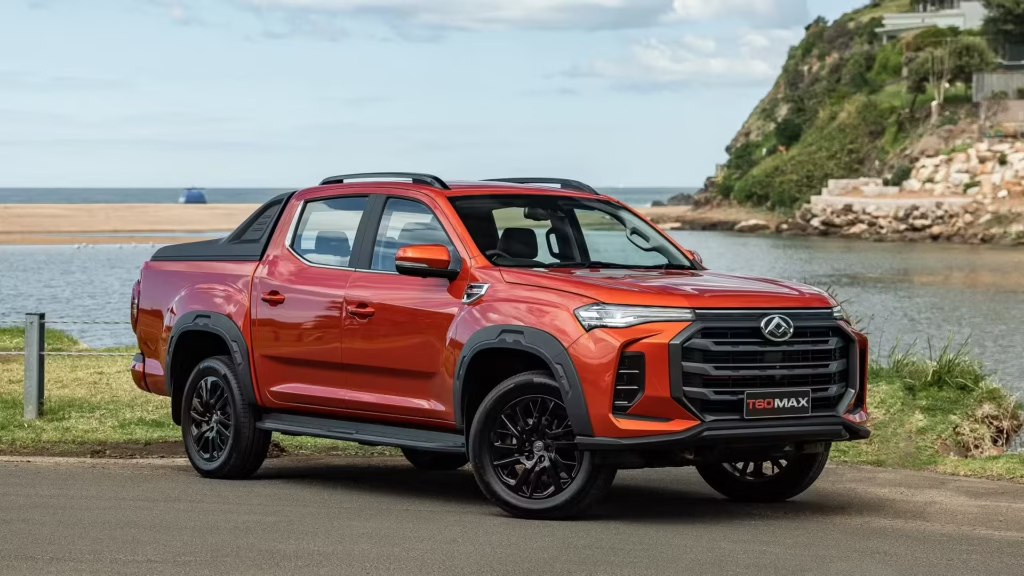

In Beijing, there is a real fight between Chinese and Korean electric vehicles. Hyundai and Kia have been reduced to a rounding error: a combined market share under 2 percent, down from roughly 10 percent back in 2009, chased out by the very wave of domestic manufacturers now following them abroad.
This isn’t happening in the United States, where a 100 percent tariff on Chinese-built EVs keeps BYD and MG off American lots entirely. The actual battlefield is neutral ground: European showrooms, Southeast Asian ports, and increasingly the UK high street, where all four brands compete on genuinely open terms.
BYD still leads

Let’s start from the global scale, because it reframes everything that follows. BYD reclaimed the world BEV sales crown from Tesla in the second quarter of 2026 with roughly 600,000 units, even as its domestic Chinese deliveries fell nearly 46 percent year on year in the first half of 2026. That’s not a contradiction so much as a strategy shift: the price war at home has become so brutal that BYD’s growth increasingly depends on exports, which hit a record 44 percent of total production in the same period.
Hyundai and Kia, despite their China exodus, still rank third among all global automakers by market share at 7.6 percent as of mid-2026, behind only Toyota and Volkswagen. So this isn’t a fading giant against a rising one. It’s two very different kinds of scale colliding on someone else’s turf.
Two different bets under the skin
BYD’s edge starts at the cell. Its Blade Battery uses lithium iron phosphate (LFP) chemistry in a cell-to-body structure that integrates the pack into the car’s chassis. The latest Blade Battery 2.0, released in March 2026, claims an energy density of 190 to 210 Wh/kg and 8C charging, enough to go from 10 to 80 percent in around 10 minutes.
Layered on top is BYD’s new Super e-Platform, a 1,000-volt architecture debuting in the Han L and Tang L that claims up to 1,000 kW charging and over 1,080 horsepower from a dual-motor setup. MG runs the same broad LFP playbook through SAIC’s joint cell development with CATL, visible in models like the MGS5 (badged ES5 in China), though without BYD’s in-house chip supply or flagship-level charging claims.

Hyundai and Kia tell a different story through their shared E-GMP platform: nickel-manganese-cobalt (NMC) cells from SK On, LG Energy Solution, and Samsung SDI, running an 800-volt architecture on flagship models like the Kia EV9 (240 kW DC charging, up to 541 km WLTP range) and Hyundai Ioniq 6 (233 kW charging, up to 614 km WLTP from a 77.4 kWh pack).
That chemistry has historically meant more range and faster real-world charging per kilowatt-hour, at a real cost premium. But the line is blurring fast: Hyundai’s new Ioniq V, a China-only sedan that debuted at the Beijing auto show in April 2026, runs on CATL-sourced LFP cells and starts at roughly $17,800, a clear sign Hyundai is borrowing the Chinese cost playbook to compete on China’s own turf. Kia’s junior E-GMP models (EV3, EV4, EV5) similarly drop to a cost-optimized 400-volt system, with charging capped around 128 kW, noticeably slower than the flagship EV9.
Where the price tags actually collide
UK pricing offers the cleanest apples-to-apples view, since it’s one of the few markets where all four brands sell openly, side by side:
| Segment | Chinese entry | Korean entry |
|---|---|---|
| City car | BYD Dolphin Surf: from £18,650, up to 322 km (200 mi) WLTP | Hyundai Inster: from £23,755, up to 369 km (229 mi) WLTP |
| Compact SUV | BYD Atto 3 Evo: from £38,990, up to 509 km (316 mi) WLTP | Kia EV3 Long Range: from £33,055, up to 604 km (375 mi) WLTP |
| Mid-size sedan | BYD Seal: from £45,705, up to 570 km (354 mi) WLTP | Hyundai Ioniq 6: from £46,985, up to 614 km (382 mi) WLTP |
The pattern isn’t as one-sided as it looks. BYD wins the city-car segment outright on price, but Kia actually undercuts BYD’s compact SUV while claiming a longer range, and Hyundai’s Ioniq 6 edges out the Seal on range despite a similar starting price.
Worth noting, too: the EV3 topped What Car?’s UK reliability survey as the highest-scoring pure-electric model of any size or badge, a track record no Chinese rival can currently match. The spec sheet alone doesn’t settle this.
The tariff maze that decides who even gets to compete
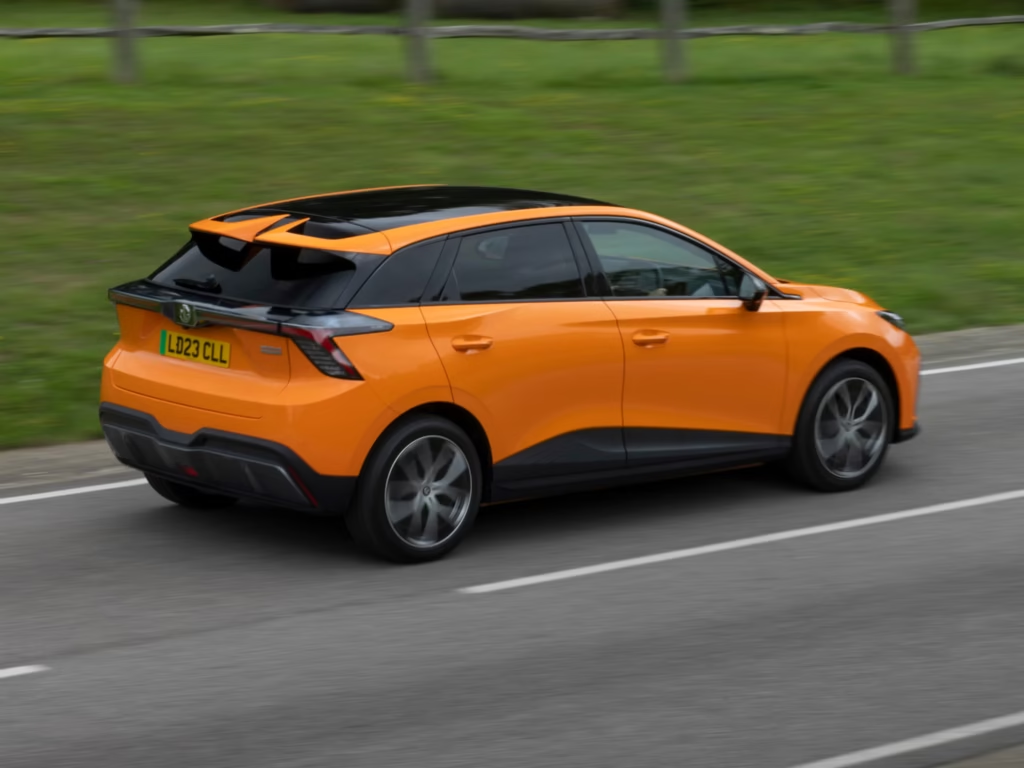
Trade policy might be the single biggest variable here. In the European Union, BYD pays a 17 percent countervailing duty on top of the standard 10 percent import tariff (27 percent total), while SAIC, MG’s parent, pays a much steeper 35.3 percent countervailing duty (45.3 percent total).
That gap explains a lot: MG has leaned hard into plug-in hybrids, which face only the standard 10 percent duty, to keep growing in Europe, and it’s now building its first European factory in Spain, a 200 million euro plant with 120,000 units of annual capacity, specifically to sidestep the tariff wall altogether. Brussels is already moving to close that PHEV loophole too, with an anti-subsidy investigation into Chinese plug-in hybrids underway as of mid-2026.
In the United States, the calculus is even starker. Chinese-built EVs face that roughly 100 percent Section 301 tariff, effectively barring BYD, MG, and every other mainland brand from the market. Hyundai and Kia, meanwhile, build extensively on North American soil, with Kia’s plant in West Point, Georgia, Hyundai’s Metaplant in Bryan County, and a new Kia EV3 line now running in Pesquería, Mexico.
That gives both brands essentially unimpeded access to the one market their rivals cannot legally enter. Canada slightly cracked open its own door in January 2026, cutting its tariff on Chinese EVs from 100 percent to just 6.1 percent under an annual import quota, but the US line hasn’t moved.
Southeast Asia flips the script entirely. Chinese brands hold something like 70 to 80 percent of Thailand’s EV market, with BYD alone commanding around 40 percent, and roughly two-thirds of Indonesia’s EV imports are Chinese as well. Hyundai and Kia compete there too and are ramping up local production to do so, but they’re playing catch-up on a pricing structure that the Chinese brands built first.
Reliability, software, and the assisted-driving arms race

Here the picture genuinely favors the incumbents, albeit unevenly. In What Car?’s UK brand reliability rankings, Kia placed 8th overall among roughly 30 brands, Hyundai 14th, and MG dead last, though MG’s score jumped from 76.9 percent to 88.9 percent in a single year, the fastest improvement of any brand on the list.
BYD hasn’t been in the UK long enough to register its own brand score, though its 8-year battery warranty and relatively strong showing in JD Power’s China dependability studies suggest it’s the sturdiest of the mainland brands so far. Reliability doesn’t map neatly to nameplate, either: the class-leading EV3 shares its E-GMP bones with the Hyundai Ioniq 5, which landed among the least reliable EVs in the same survey, with 42 percent of owners reporting a fault, frequently a 12-volt battery gremlin that could leave the car undrivable.

The two sides also disagree philosophically on driver assistance. BYD’s “God’s Eye” ADAS suite spans three hardware tiers and, following a 2026 relaunch, starts at roughly $1,770 as an option even on the sub-$10,000 Seagull hatchback, using a DeepSeek-trained model and camera, radar, and lidar combinations that BYD markets as Level 3 capable on certain trims, with the company covering accident liability while the system is engaged.
Hyundai and Kia’s Highway Driving Assist 2 is a more conservative, trim-gated Level 2 system: adaptive cruise, lane centering, and assisted lane changes, hands firmly required on the wheel throughout. One side is racing to democratize semi-autonomous features as a volume play; the other is building trust incrementally around a system that makes no dramatic promises.
Our Take
If the priority is spec-per-dollar (range, charging claims, standard equipment), BYD wins comfortably, and MG isn’t far behind once you accept its steeper EU tariff exposure and its recent, if rapidly improving, reliability history. If the priorities are resale value, dealer network depth, and a proven ownership record, Kia and Hyundai remain the safer bets, and Kia specifically is closing the reliability gap on its own EVs faster than Hyundai has.
Where you live changes the answer more than any spec sheet: in the US, this whole debate is currently theoretical; in China, it’s already been decided; and the genuinely open contest, the one worth watching over the next few years, is unfolding across Europe and Southeast Asia, where nobody has home-field advantage.

Hillary started his automotive writing journey at HotCars, and has written for CarNewsChina, GlobalSUV, and many other top auto blogs.
He loves to read, play chess, and supports Liverpool during the weekends