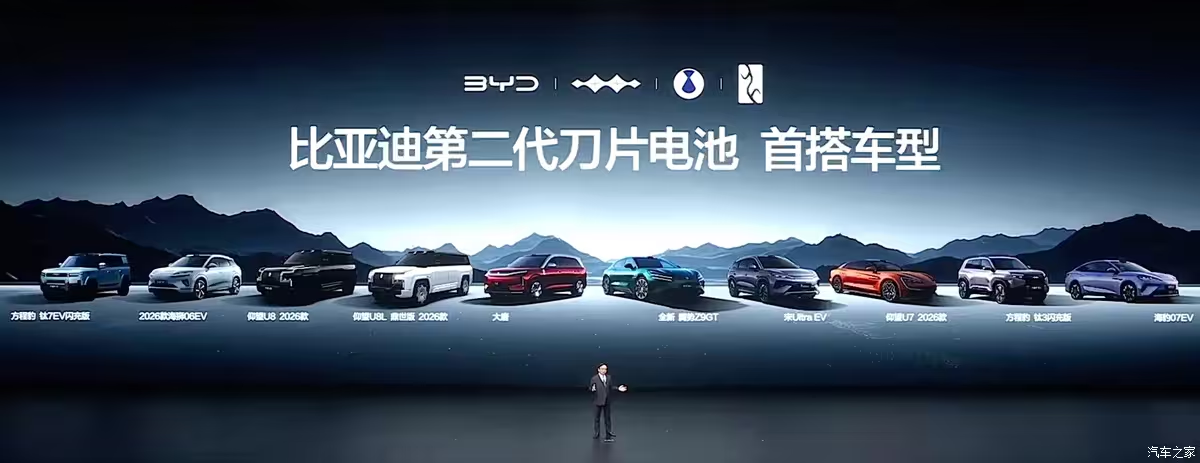
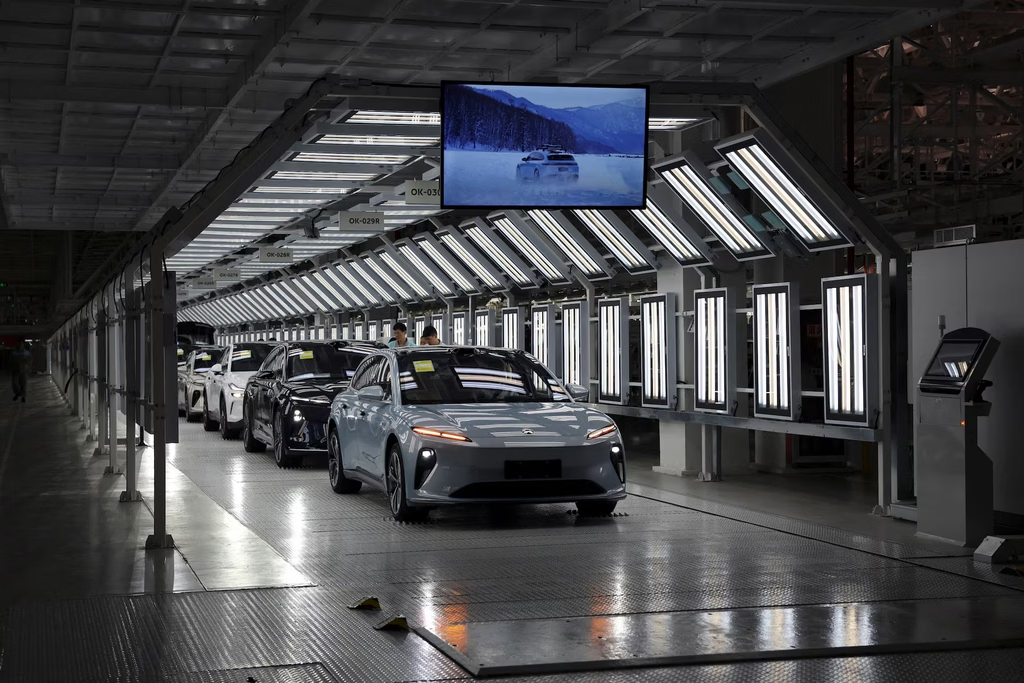
BYD outsold every other electric vehicle maker on the planet in 2025, moving roughly 4.6 million EVs and plug in hybrids combined against Tesla’s 1.6 million all electric cars. Its cheapest model, the Seagull, sells for around $7,800 in China.
Meanwhile, the average EV sold in the United States runs north of $55,000, according to Cox Automotive. By any normal market logic, an $8,000 BYD hatchback should already be undercutting everything on American dealer lots.
It isn’t, and for now it can’t be. Not because American drivers don’t want one, and not because BYD hasn’t tried. Chinese EVs are locked out of the US by a wall built from two very different kinds of material: punishing tariffs, and a national security regulation that doesn’t care what anything costs. In 2026, Washington has spent the year adding a third layer, one designed to make the whole structure much harder to ever tear down.
The Tariff Wall the Supreme Court Couldn’t Touch

Start with the money. In 2024, the Biden administration used Section 301 of the Trade Act to quadruple the tariff on Chinese made electric vehicles, from 25 percent to 100 percent. Add the roughly 2.5 percent baseline duty every passenger car pays entering the US, and the effective rate lands around 102.5 percent. A Chinese EV priced at $20,000 in its home market would effectively cost more than $40,000 once it clears US customs, before a dealer marks it up another dollar.
Section 232 of the Trade Expansion Act layers on a second tariff, a 25 percent duty on imported vehicles and auto parts that the Trump administration imposed on national security grounds in 2025. It’s a broader tool aimed at the global auto trade rather than China specifically, but for Chinese EVs it simply stacks on top of a rate that was already prohibitive.
Here’s the part that caught a lot of trade lawyers off guard this year. On February 20, 2026, the Supreme Court ruled 6 to 3 that the International Emergency Economic Powers Act never actually gave the president authority to impose tariffs, striking down the sprawling reciprocal tariff regime built since 2025 and sending billions of dollars in refunds back to the lower courts to sort out.
It was the single biggest legal reset to US trade policy in years, but it didn’t move the price of a Chinese EV by one dollar. Section 301 and Section 232 are older, separate statutory authorities the Court never questioned, and the tariffs keeping Chinese EVs out of the country rest entirely on those two.
The Wall That Has Nothing to Do With Price

Tariffs are, in theory, negotiable. A future trade deal could roll them back in an afternoon. The bigger obstacle for Chinese automakers isn’t about price at all, which is exactly what makes it so much harder to undo.
In January 2025, in one of the Biden administration’s final acts, the Commerce Department’s Bureau of Industry and Security finalized the Connected Vehicles Rule. It treats a modern car less like a machine and more like a rolling computer with a data problem. The rule bars the sale of any vehicle in the US whose connectivity or automated driving software was designed, developed, or supplied by an entity linked to China or Russia, regardless of where the car is assembled or which badge sits on the hood.
Compliance for software became mandatory on March 17, 2026, tied to model year 2027 vehicles. A parallel ban on hardware, covering things like telematics control units and cellular modems, follows with model year 2030.
The reasoning comes down to what a connected car can see and send. A modern EV’s cameras, GPS, and always on cellular link can log driver habits, home addresses, and the roads around sensitive infrastructure, then route that data through a supply chain Washington doesn’t trust. Whether or not a given buyer cares about any of that, the rule doesn’t ask. It just prohibits the sale outright.
Polestar Shows How Wide the Net Really Is
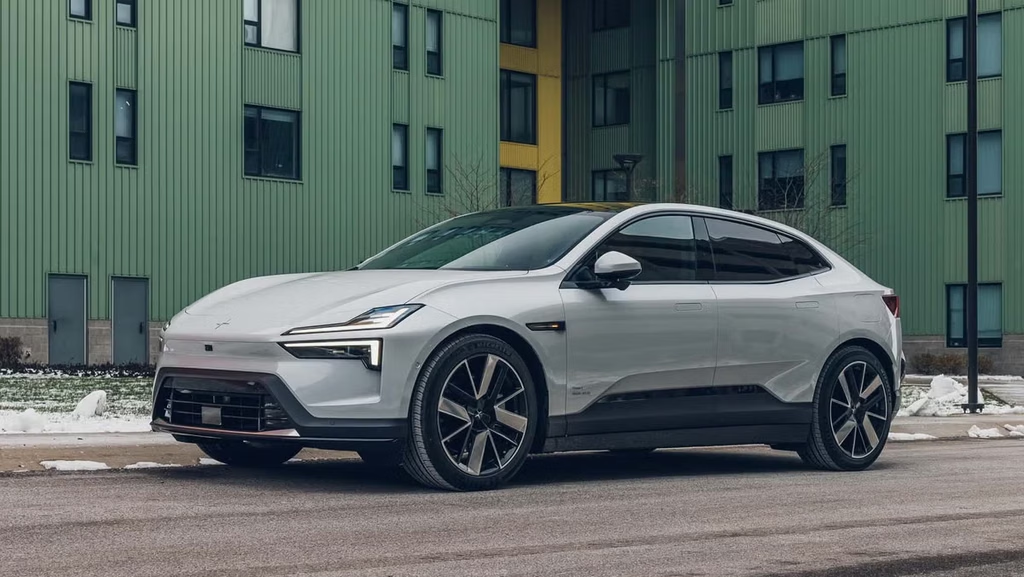
If anyone still assumed this was only about barring cars with Chinese badges, Polestar’s summer proved otherwise. The Swedish brand builds its cars in China and is majority owned by Geely, and in late June 2026 the Commerce Department declined to authorize its future models, effectively ending new Polestar sales in the US from the 2027 model year onward.
The company will keep servicing existing owners and selling remaining inventory, but nothing new comes after that. Executives responded by leaning harder into Europe, already the large majority of Polestar’s volume, and confirming the next model, the Polestar 7, will be built in Slovakia instead.
What stung most was the company sitting right next to Polestar on the org chart. Volvo, also tied to Geely founder Li Shufu, secured its own US authorization around the same time. Ford is separately seeking approval for its China built Lincoln Nautilus, and General Motors is restructuring Buick Envision production specifically to move it out of China before 2028.
Ownership, software lineage, and supply chain exposure now matter more than a company’s headquarters address or the nationality most shoppers assume. That is a far stickier problem to engineer around than a tariff line.
The Mexico Shortcut That Never Opened

For a while, the obvious workaround looked geographic. Build the cars in Mexico, ship them north under USMCA’s near zero tariff terms, and let proximity do what direct exports couldn’t. BYD spent roughly two years scouting sites for a plant that would have built about 150,000 vehicles a year and created around 10,000 jobs.
It never happened. BYD shelved the project in mid-2025, citing uncertainty over Trump’s tariff plans and broader geopolitical tension. China’s own commerce ministry reportedly slow walked its approval too, wary that a Mexican plant would expose BYD’s technology to US rivals. BYD built its first plant outside Asia in Brazil instead, opening a Bahia state factory in just 15 months.
Mexico closed the rest of that door on its own terms. Facing what officials openly described as encouragement from Washington ahead of the 2026 USMCA review, Mexico’s Congress voted in December 2025 to raise tariffs on vehicles from countries without a free trade agreement, China included, from 20 percent to 50 percent, effective January 1, 2026. Chinese made car imports fell sharply within weeks. Brands like MG and Changan kept notching sales gains through the first quarter by selling down inventory that arrived before the tariff hit, but the pipeline behind them has clearly narrowed.

Canada broke from that pattern entirely. On January 16, 2026, Prime Minister Mark Carney struck a deal in Beijing that cuts Canada’s 100 percent tariff on Chinese EVs down to the standard 6.1 percent rate, for a quota of 49,000 vehicles a year growing to 70,000 within five years, in exchange for China slashing its own tariff on Canadian canola.
It’s a narrow opening, and officials expect the first vehicles through it to be Chinese built Teslas and Volvos rather than BYDs, since most Chinese branded models still aren’t certified for the Canadian market yet. But it’s a real crack in what had been a unified North American front, and it leaves the United States looking more isolated in its own backyard than it did a year ago.
Congress Wants to Weld the Wall Shut

Executive branch rules can be undone by a future executive branch. That’s precisely what a bipartisan group in Congress is trying to prevent. The Connected Vehicle Security Act of 2026, introduced in April by Senators Bernie Moreno and Elissa Slotkin with a companion bill from Representatives John Moolenaar and Debbie Dingell, would take the Commerce Department’s rule and write it directly into law, then expand it further.
The bill folds in Russia, Iran, and North Korea alongside China, gives Commerce broader authority to flag emerging risks, and keeps the same phased timeline the existing rule already runs on: software restrictions starting in 2027, hardware in 2030.
The Senate Commerce Committee passed it unanimously on July 22, 2026, backed by a coalition ranging from the United Auto Workers to General Motors to the Steel Manufacturers Association, groups that rarely agree on much else.
A separate bill, the Protect America from Chinese Cars Act, targets a specific loophole lawmakers worry about: connected Chinese vehicles crossing into the US from Canada or Mexico without ever going through a formal import process. Neither bill has reached a full floor vote yet, but the direction of travel is unmistakable. Congress wants this exclusion to outlast any single administration or trade negotiation.
Our Take
Compare all this to how Europe handled the same problem. The EU imposed its own tariffs on Chinese EVs in 2024, ranging from 17 percent for BYD up to 38 percent for SAIC, stacked on a 10 percent standard duty. Steep, but not prohibitive, and Chinese brands adapted fast.
BYD leaned into hybrids that dodge the tariff entirely, broke ground on a Hungarian factory set to start production before the end of 2026, and actually overtook Tesla in European registrations during the first half of the year. While the EU chose to tax the problem, the US chose to ban it.
That distinction is what makes the American situation so durable. A tariff is a lever a future administration or trade negotiator can pull back at will, the way Canada just did. A security regulation, especially one Congress is racing to lock into statute, is a different kind of wall entirely, one that was never really about price to begin with.
Until that changes, the company selling the world’s cheapest, fastest growing EVs will keep watching the largest car market on the planet from the outside, unable to get in no matter how far the sticker price drops.

Hillary started his automotive writing journey at HotCars, and has written for CarNewsChina, GlobalSUV, and many other top auto blogs.
He loves to read, play chess, and supports Liverpool during the weekends