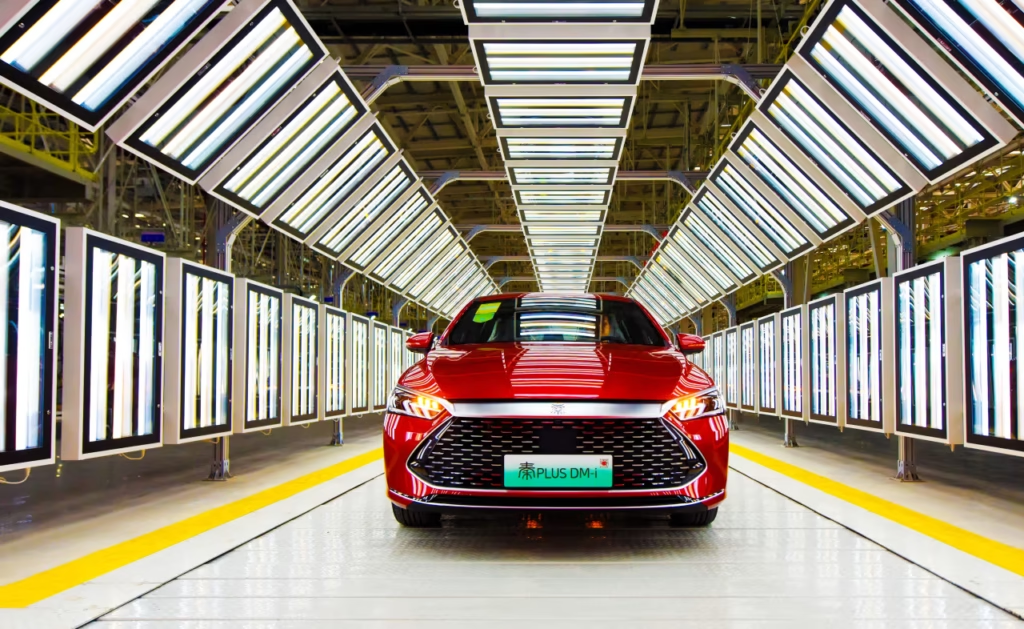

Chinese automakers are actually pouring concrete in Europe, and two countries keep coming up: Hungary and Turkey. Both were supposed to solve the same problem for BYD, Chery, Great Wall Motor and their peers: how to keep selling into the European Union once Brussels decided their electric vehicles deserved a tariff bill on arrival.
Eighteen months later, the two bets have produced strikingly different results, and the gap between them explains more about how Chinese carmakers are learning to navigate European trade politics than any tariff schedule ever could.
Why Hungary and Turkey

Start with the tariff that set all of this in motion. On October 29, 2024, the European Commission closed out its anti-subsidy investigation into Chinese battery electric vehicles, imposing definitive countervailing duties ranging from 7.8 percent to 35.3 percent, depending on the manufacturer, stacked on top of the EU’s standard 10 percent car tariff, for a term of five years.
For a mass-market EV built in China and shipped to Rotterdam or Antwerp, that gap is often the difference between undercutting the competition and simply matching it. Building somewhere inside, or at least tariff-free into, the EU’s 27-country market stopped being a nice-to-have and became core strategy almost overnight.
That is where Hungary and Turkey come in. Hungary is a full EU member, so anything built there counts, by definition, as European production. Turkey is not an EU member, but it has operated inside a customs union with the EU since 1995, one that covers industrial goods including passenger cars. Vehicles that clear Turkish customs in free circulation can cross into the EU without paying duty, the same arrangement that has kept Ford, Toyota, Stellantis, Renault and Hyundai building cars there for decades.
On paper, both routes land a Chinese automaker in the same place: a car that reaches a European dealer without an extra 7.8 to 35.3 percent stapled to the invoice. In practice, only one of the two has actually started building cars.
Hungary’s head start

BYD’s relationship with Hungary predates the tariff fight by years. The company has assembled electric buses in Komarom since 2017 and runs battery assembly operations in Fot and Paty, so when it announced in December 2023 that it would build its first European passenger car plant in Szeged, it was extending an existing relationship.
The Szeged project, reportedly worth up to 4 billion euros, is designed to eventually build as many as 300,000 vehicles a year, though Hungarian officials have also cited a nearer-term ceiling closer to 200,000. Production will start with the Dolphin Surf hatchback, sold in China as the Seagull, before expanding to the Atto 3, Dolphin, Seal and Sealion 6 lines.
The timeline has slipped more than once. BYD originally promised production before the end of 2025, then pushed that to the second quarter of 2026 once trial production quietly began in January, and by June 2026 the company was describing a further delay, with full series production now targeted for the fourth quarter of the year.
That is a company that has repeatedly missed its own dates. It is also a company that has broken ground, installed equipment, and begun building cars, putting it well ahead of every other Chinese automaker pursuing the same goal. BYD also moved its European headquarters from the Netherlands to Budapest in 2025 and opened a research center there focused on driver assistance software, a sign that Szeged is meant to be a foundation rather than a one-off factory.

Hungary’s appeal goes well beyond a single automaker. Prime Minister Viktor Orban’s years-long courtship of Asian manufacturing investment, often described as a “look East” strategy, has combined tax breaks and infrastructure support with a market that already hosts a dense cluster of Western automotive plants, including BMW in Debrecen, Audi in Győr and Mercedes-Benz in Kecskemét.
There is also a battery boom: CATL is building a roughly 7.3 billion euro, 100 gigawatt-hour battery plant in Debrecen, described as the largest greenfield investment in Hungarian history, supplying BMW, Mercedes-Benz, Stellantis and Volkswagen. South Korea’s SK On and Samsung SDI, Japan’s GS Yuasa, and China’s Nio all run battery projects in the country as well, and Great Wall Motor is now weighing Hungary against Spain for its first European vehicle plant, targeting 300,000 units a year by 2029.
None of this has gone smoothly. CATL’s Debrecen plant has slipped its own schedule too, and as of mid-2026 it had yet to produce a single battery cell, forcing Mercedes-Benz to source cells from China for a new electric van while it waits, with BMW’s local cell supply now pushed back to 2027. While building in Hungary doesn’t guarantee Chinese investment arrives on schedule, it keeps getting chosen again anyway. Because the underlying case- EU membership, an established supply chain, and a government reliably eager to say yes- stays intact even when individual projects run late.
Turkey’s harder sell

Turkey’s pitch was, if anything, more straightforward on paper: tariff-free access to the EU without the political weight of investing inside the bloc, lower labor costs, a currency that has made local manufacturing cheaper in dollar terms, and Black Sea and Aegean ports within easy shipping range of Europe, the Middle East and Central Asia.
BYD signed a $1 billion deal for a 150,000-unit electric and plug-in hybrid vehicle plant in Manisa in July 2024, with the signing ceremony personally hosted by President Recep Tayyip Erdogan. Chery followed with a project reportedly worth $1 billion to $1.5 billion for a 150,000 to 200,000-unit plant building electric and plug-in hybrid models in the Black Sea city of Samsun, announced with similar fanfare in early 2025, though Chery itself briefly denied to Reuters that it had firm plans to build there at all, saying at the time it was exploring a third-party partnership instead.
Two years on, neither project has broken ground. BYD confirmed in June 2026 that Manisa was on indefinite hold, signaling that Hungary had become its clear priority and that Turkey no longer had a fixed timeline. Ankara had already suspended BYD’s import tax exemptions earlier in the year over the stalled construction, and opposition lawmakers have since pressed ministers on what will happen to the incentives already granted if the plant never materializes.

Chery’s Samsun project has fared little better. As of late August 2026, the roughly 1.2 million-square-meter site in Tekkekoy still had no construction on it, more than two years after talks began, with Chery reportedly in early discussions about co-producing vehicles with Nissan in Britain as a parallel option.
The explanations offered mix the commercial with the geopolitical. BYD has pointed to the rising cost of EU tariffs making Turkish-built cars comparatively less attractive than EU-built ones. Turkey’s customs union covers ordinary trade tariffs, but the EU’s anti-subsidy duties are a separate, more targeted instrument aimed squarely at Chinese manufacturers, and executives increasingly see assembly inside an actual member state as the sturdier shield against it.
Local officials in Manisa have also pointed to the broader US-China trade tensions that ran through 2025 as a factor spooking the investment timeline. None of it has stopped Turkish officials from continuing to court Chinese money, but the contrast with Hungary’s real, if delayed, factory is getting harder to explain away.
Our Take
Chinese automakers have a track record of announcing investment numbers that shift by the time ground actually breaks, and BYD’s own two projects illustrate the point in opposite directions: Hungary slower to open than promised, Turkey not yet begun at all.
There is one more wrinkle worth watching. In January 2026, the European Commission published guidance allowing individual Chinese BEV exporters to propose price undertakings, essentially a minimum selling price paired with an import quota, as an alternative to the countervailing duties, and by February it had accepted its first such offer covering a single model.
That could look like it removes the whole rationale for building factories in Europe at all. It probably does not. Each undertaking has to be negotiated model by model and approved case by case, and the guidance explicitly asks applicants to lay out planned investments inside the EU as part of the offer. Brussels, in other words, is using local manufacturing as leverage in the very negotiation that might otherwise make it unnecessary.
For now, that leaves Hungary as the place where Chinese electric vehicles are actually rolling off European assembly lines, however late, and Turkey as the bridge that looked shorter on paper than it has proven to be in practice. Spain is worth watching next. It keeps resurfacing as the fallback for both BYD and Great Wall Motor, and if either commits to it, the two-country story will need a third chapter.

Hillary started his automotive writing journey at HotCars, and has written for CarNewsChina, GlobalSUV, and many other top auto blogs.
He loves to read, play chess, and supports Liverpool during the weekends