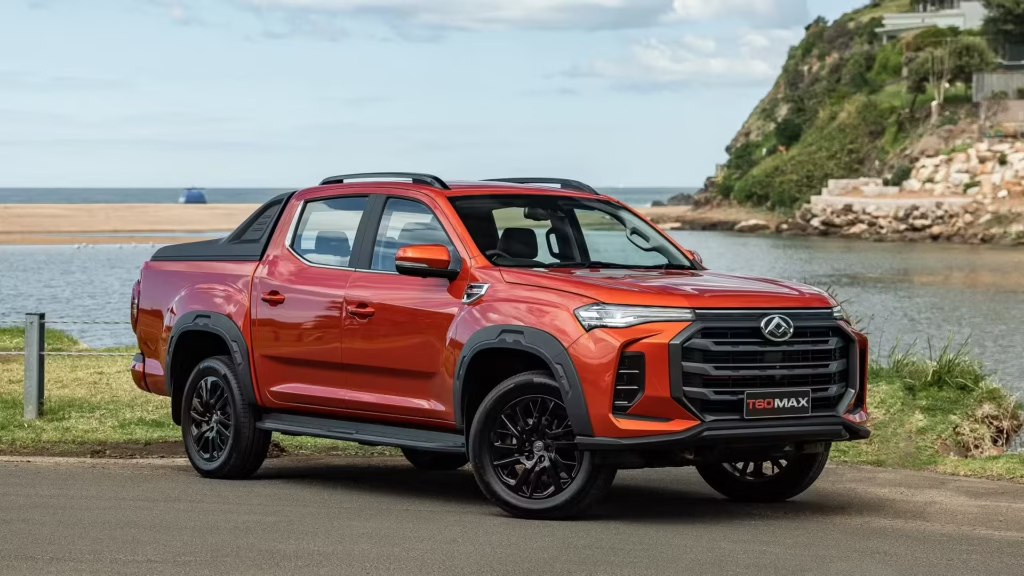

When a Chinese EV saves you £7,000 to £11,500 on the sticker price versus a comparable European model, that saving is real and immediate. What buyers often do not calculate before signing is what happens to that saving over three or five years of ownership, once insurance, servicing, depreciation and charging costs are added to the picture. According to CarCostCheck’s 2026 running cost analysis, depreciation is the largest single cost of car ownership and the area where Chinese EVs currently present the most uncertainty. The sticker price advantage is genuine. The total cost of ownership case is more nuanced, and it depends significantly on how you charge, how long you keep the car, and which brand you choose.
This guide works through every major cost category for the two most widely owned Chinese EVs in the UK: the MG4 and the BYD Seal, with the BYD Atto 3 referenced where relevant. The figures are drawn from published data rather than estimates. Where data is unavailable or incomplete because Chinese EVs are too new to the UK market to have generated it, this article says so directly.
Five-Year Ownership Cost Comparison
Estimated five-year total cost of ownership, UK, 10,000 miles per year, home charging
| Cost category | MG4 Long Range | BYD Seal (Long Range) | VW ID.3 Pro (comparable) |
| Purchase price (OTR) | £29,995 | £44,695 | £38,395 |
| Depreciation (3-yr est.) | 45-52% / ~£14,400 | 42-48% / ~£19,800 | 48-55% / ~£18,600 |
| Annual insurance (est.) | ~£900-1,100 /yr | ~£1,100-1,400 /yr | ~£850-1,050 /yr |
| Annual servicing | ~£200-300 /yr | ~£200-300 /yr | ~£250-350 /yr |
| Charging (home, 7p/mile) | ~£700 /yr | ~£700 /yr | ~£700 /yr |
| Road tax (VED) | £195 /yr (from Apr 2025) | £195 /yr (from Apr 2025) | £195 /yr (from Apr 2025) |
| Est. 5-year total cost | ~£36,900 | ~£55,500 | ~£48,300 |
Depreciation figures from DriveAuthority 2026 and CarCostCheck 2026. Insurance estimates from Confused.com average EV group data. Servicing from published BYD and MG service schedules. Charging cost assumes 3.5 miles/kWh at 24.5p/kWh home rate. VED applies from April 2025 to all EVs at the standard rate. Five-year total includes purchase price minus estimated resale value, plus accumulated running costs. Estimates only — verify with your insurer and dealer.
The Five Cost Categories

1. Purchase Price
The purchase price advantage on Chinese EVs is best understood as a bracket rather than a single number. According to DriveAuthority’s May 2026 price comparison, the saving is strongest between £26,000 and £42,000, where Chinese EVs typically undercut comparable European and Korean models by £7,000 to £11,500. The MG4 Long Range at £29,995 is one of the best Chinese EVs in the UK under 35,000. Above £45,000, the gap narrows to £2,000-£3,100, and the case weakens. Below £26,000, the BYD Dolphin Surf at £18,650 has essentially no direct competitor at that price point, making the comparison academic.
For salary sacrifice buyers, The Electric Car Scheme calculates that the MG4 Long Range saves £22,460 over 36 months compared with a personal PCP on the same car, once tax savings and BiK rates are factored in. That is a significant number, and it is the reason the Jaecoo E5 became the UK’s top-selling salary sacrifice EV in Q4 2025 despite being largely unknown among general consumers.
2. Depreciation
Depreciation is where the ownership picture becomes more complicated. CarCostCheck’s 2026 analysis places budget Chinese EVs like the MG4 and BYD Atto 3 at 45 to 52 percent depreciation after three years, compared with 55 to 60 percent retention for the Tesla Model 3 and around 55 to 61 percent for Hyundai Ioniq models. DriveAuthority’s real-world testing guide puts the BYD Seal’s three-year depreciation at 42 to 48 percent, marginally better than the MG4 but still behind the Model 3’s 35 to 40 percent.
For buyers purchasing outright and keeping the car beyond five years, depreciation is a paper loss rather than a cash one. For buyers on three-year PCP finance, it determines the guaranteed future value the finance company sets at the start of the contract. If the market value at return is lower than the GFV, the finance company absorbs the loss. If it is higher, the buyer benefits. Chinese EVs are newer to the UK used market, which means GFV calculations carry more uncertainty for both parties.
The buyers for whom depreciation matters least are those keeping the car for five years or more. The buyers for whom it matters most are those on short-term PCP deals planning to change every three years.
3. Insurance
Electric cars are more expensive to insure than equivalent petrol cars, and Chinese EVs carry an additional premium on top of that. CarCostCheck identifies three reasons: battery replacement costs of £5,000 to £20,000 or more, a still-limited network of specialist EV repairers, and longer repair times because fewer independent mechanics are trained on EV systems. Chinese EVs add a fourth factor: parts supply chains that are less established in the UK than those of European or Japanese brands, which can lead to longer waits for replacement components and higher labour costs at specialist centres.
In practice, DriveAuthority’s quality and reliability guide estimates insurance premiums running 15 to 25 percent higher for Chinese EVs than for comparable established-brand models. On an MG4, that translates to approximately £900 to £1,100 annually for a typical UK driver, versus £700 to £900 for a comparable petrol hatchback. The gap is real but not prohibitive. It is worth getting quotes from multiple insurers before purchase, as pricing varies significantly between providers on newer Chinese models where claims data is still thin.
4. Servicing
Servicing costs are one area where Chinese EVs hold up well against the competition. Published BYD and MG service schedules show annual servicing in the £200 to £300 range, broadly comparable to established European and Japanese brands at similar mileage. EVs have fundamentally lower servicing requirements than ICE cars: no oil changes, no timing belt replacements, no exhaust work, no spark plugs. The main service items are brake fluid checks, tyre rotation, cabin air filter replacements and software updates, the last of which accounts for over 60 percent of BYD service centre appointments and can often be handled over the air rather than in person.
The important caveat is geographic. Basic servicing such as brakes, tyres and fluids can be performed at any competent independent garage. EV-specific work on the battery, motors and software requires a dealer or approved specialist, and for some Chinese brands the approved network outside major cities remains thin. Before buying, confirm that an approved service centre is within practical distance of your home. For MG buyers, this is straightforward given the brand’s 150-plus UK service points. For newer entrants, it requires checking.
5. Charging
The financial case for any EV depends more on where you charge than on which car you choose. CarCostCheck calculates home charging at approximately 4p to 7p per mile, against 14p to 18p per mile for a typical petrol car. At 10,000 miles per year, that difference saves approximately £700 to £1,100 annually. At public ultra-rapid chargers, however, the per-mile cost rises to roughly the same level as petrol, eroding the energy saving almost entirely. The financial case for a Chinese EV, like any EV, rests heavily on regular home or workplace charging. For buyers without access to either, the running cost advantage shrinks considerably, and the higher purchase price of an EV over an equivalent ICE car becomes harder to justify on cost grounds alone.
Road tax changed in April 2025. EVs are no longer exempt from Vehicle Excise Duty and now pay the standard £195 annual rate that petrol and diesel owners pay. The expensive car supplement, at £620 per year for vehicles with a list price over £40,000, applies to EVs as it does to all other vehicles. The BYD Seal at £44,695 and the BYD Sealion 7 at approximately £47,000 both attract this supplement for the first five years of ownership, adding over £3,000 to their five-year cost that buyers moving from a Chinese EV under £40,000 may not anticipate.
Who This Works For and Who It Does Not

The total cost picture favours Chinese EV ownership most strongly for buyers who charge at home, keep the car for at least four years, and are buying in the £28,000 to £42,000 bracket where the sticker price saving is largest. CarCostCheck concludes that high-mileage drivers on home charging are almost certain to save versus a petrol equivalent over a five-year period, even after accounting for higher insurance and depreciation. For our more detailed breakdown of which specific models deliver the strongest value at each price point, see our guide to the best Chinese EVs under £35,000 in the UK.
The picture is less favourable for buyers on three-year PCP deals who plan to change cars frequently, for buyers without home charging who will rely primarily on public rapid chargers, and for buyers considering newer Chinese brands with thinner UK service networks. In those scenarios, the sticker price saving can be partially or wholly offset by higher depreciation risk, insurance costs and charging expenses. For anyone uncertain about the depreciation exposure specifically, salary sacrifice eliminates it entirely: the finance company carries the residual value risk, and the buyer simply pays a fixed monthly amount and returns the car at term.
Editor’s Take
The total cost of ownership argument for Chinese EVs is strongest for exactly the buyer who least needs reassurance: someone who has already done the research, has home charging, plans to keep the car for five years, and is buying in the bracket where the price advantage is largest. For that buyer, a Chinese EV is almost certainly cheaper over the ownership period than a comparable European or Korean alternative, even after insurance, depreciation and servicing are accounted for.
The buyer who needs more caution is the one buying on a short-term PCP deal primarily because the monthly payment looks attractive. The monthly payment on a £29,995 MG4 will indeed be lower than on a £38,395 ID.3 at the same deposit and APR. But the guaranteed future value set by the finance company reflects depreciation expectations, and for Chinese EVs those expectations are set conservatively because the used market data is limited. Before signing any PCP on a Chinese EV, ask the dealer explicitly what GFV has been applied and compare it with independent depreciation forecasts from sources like CarCostCheck or the What Car? valuation tool. The sticker price saving is real. Make sure the finance structure does not give it back quietly.

Hillary started his automotive writing journey at HotCars, and has written for CarNewsChina, GlobalSUV, and many other top auto blogs.
He loves to read, play chess, and supports Liverpool during the weekends