

Chinese automakers have historically treated EV platforms as fundamentally different businesses. BYD treats the platform as a battery pack with a car built around it. Geely treats it as a product in its own right, one it licenses out to Volvo, Lotus, Polestar, and Smart. XPeng treats it as a chassis built to carry a chip.
Platform architecture matters more in EVs than it ever did in the combustion era. Without an engine, transmission tunnel, or exhaust system dictating the layout, a flat “skateboard” of battery and motors can underpin a hatchback and a minivan using much of the same hardware. That flexibility has turned platform strategy into one of the clearest windows into how a Chinese automaker actually thinks about its business, not just its cars.
Here’s how BYD’s e-Platform 3.0, Geely’s SEA, and XPeng’s SEPA 2.0 each answer that question differently, and why the gap between them is widening rather than closing.
BYD e-Platform 3.0: The Battery Is the Car

BYD’s e-Platform 3.0 debuted in 2022 under the Seal sedan, and its defining idea is right there in the acronym CTB, Cell-to-Body. Most EVs bolt a battery pack underneath a separate body structure. BYD instead removes the pack’s top cover and makes the top of the cells themselves part of the passenger floor, encased in a honeycomb aluminum frame and a high-strength roll beam.
The battery isn’t installed in the car. Structurally, it is the car, which is how BYD gets away with drag coefficients as low as 0.21 and a genuinely low, wide stance despite packing in a full-size Blade Battery. That’s only possible because BYD controls the one variable everyone else has to negotiate around: the cell itself.
The Blade Battery is BYD’s own lithium iron phosphate design, long and thin enough to be load-bearing and, per BYD, able to pass a nail penetration test without triggering thermal runaway. Because BYD makes its own cells, motors, and power electronics through subsidiaries like FinDreams, it can tune all of them as one system rather than integrating parts sourced from a dozen outside suppliers.

The result is an 8-in-1 electric drive unit, motor, controller, reducer, charger, and converter folded into a single housing, running on switchable 400V or 800V electrics with motors spinning up to 23,000 rpm.
The platform’s 2024 refresh, e-Platform 3.0 Evo, pushed the integration further: a 12-in-1 drive unit, another 100mm of front crumple space, a claimed 60 percent gain in both frontal collision safety and regional body strength, and under 5mm of pedal intrusion in China’s C-NCAP frontal test, launched alongside the Sealion 07.
It’s an aggressively vertically integrated approach, closer to how BYD already builds phones and buses than how a traditional automaker builds cars, and it’s the reason BYD can sell a sub-$11,000 Seagull city car and a 1,000-horsepower Han L performance sedan off the same underlying architecture without either feeling like an afterthought.
Geely SEA: The Platform as a Product

Geely took the opposite bet. Instead of building a platform to serve its own brands exclusively, it built Sustainable Experience Architecture, SEA (its Chinese name, Hàohàn, translates loosely to “vast” or “boundless”), as something closer to an operating system for other people’s cars.
SEA was developed largely in Gothenburg, Sweden, by Zeekr Technology Europe, the same engineering house (formerly known as CEVT) that has long done core development work for Volvo, and Geely explicitly markets the architecture as “open source,” meaning outside automakers can license it rather than build their own from scratch.
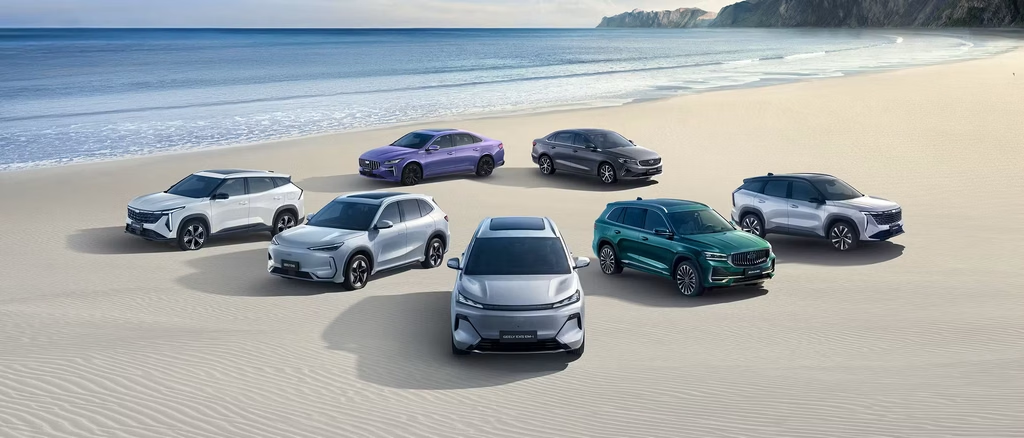
That bet has produced an unusually diverse family tree. SEA1 and SEA2 cover mainstream sedans and SUVs, underpinning the Zeekr 001 and 009 as well as the Lotus Eletre, Polestar 5, and Volvo EM90. SEA-S scales up further for large luxury SUVs like the Zeekr 9X. SEA-C is rated to handle commercial vehicles between 3.5 and 5.5 tonnes, including buses and pickups.
And SEA-M strips the architecture down to a flat-floor, no-B-pillar skateboard aimed squarely at autonomous mobility, the version Waymo chose as the basis for its Zeekr-built robotaxi. Large aluminum die-castings, similar in spirit to Tesla’s gigacasting, form the rear underbody as a single piece on models like the 009, cutting nearly 800 welding points out of the assembly process.
Layered on top of the SEA hardware is Geely’s GEEA electronic architecture, now in its third generation, which consolidates what used to be more than a dozen separate control modules into two, a central “super brain” plus regional zonal controllers, linked over an automotive Ethernet backbone. It’s the software nervous system that lets a SEA-based car gain new features through an update rather than a trip to the dealer.
XPeng SEPA 2.0: The Chassis for a Chip

If BYD optimizes for the battery and Geely optimizes for licensing, XPeng optimizes for the software stack riding on top. SEPA 2.0, Smart Electric Platform Architecture, launched in 2023 under the G6 SUV as a genuinely flexible skateboard, engineered for wheelbases from 1,800mm to 3,200mm and adaptable across sedans, coupes, wagons, SUVs, MPVs, and even pickups, with roughly 80 percent parts commonality between models built on it.
Its headline hardware is an 800V silicon carbide electrical system paired with XPeng’s own in-house XPower drive unit, which the company claims reaches 97.5 percent peak efficiency, plus a CIB (Cell Integrated Body) structure that folds the battery into the chassis in much the same structural spirit as BYD’s CTB.
But SEPA 2.0’s real purpose sits upstream of the hardware: it exists to make XPeng’s XNGP driver-assistance software portable across the whole lineup, cutting the R&D cost of adapting that software to a new model by a claimed 70 percent, and it’s built alongside X-EEA, XPeng’s own electronic architecture, and Xmart OS, its in-car software layer.

That software-first logic reached its clearest expression with SEPA 3.0, introduced in 2025 and underpinning newer models like the flagship GX SUV. It bumps charging to 5C and hands more control to XPeng’s self-designed Turing AI chip, the same silicon doing duty in the company’s Guangzhou robotaxi line.
More strikingly, SEPA 3.0 also quietly walks back one of XPeng’s founding principles: it now supports a range-extended (EREV) powertrain alongside pure battery-electric, pairing a compact 63.3 kWh battery with a backup combustion generator on models like the P7+. For a brand that spent years positioning itself as an electric-only purist, building a gasoline safety net into its next-generation architecture is as much a strategy statement as any spec on the sheet.
Why the Differences Matter Beyond China

These aren’t just engineering choices, they’re bets on where the money is. BYD’s approach turns platform ownership into a manufacturing cost advantage: almost nobody else on this list makes its own cells, motors, and chips at BYD’s scale, so almost nobody else can match its price-to-range ratio as easily.
That’s precisely the capability BYD has started renting out to rivals. Toyota has licensed BYD’s e-platform technology for a jointly developed EV, and Hyundai has licensed Blade Battery technology, early signs that BYD increasingly sees the platform itself, not just the cars built on it, as an export product in its own right.
Geely got there first with a more explicit version of the same idea. SEA was designed from day one to be licensed, and it already underwrites cars sold under five different brand badges across three continents, arguably making Geely as much a platform supplier to the industry as it is a carmaker, a role more commonly associated with legacy giants like Bosch or Magna than with a Chinese automaker.
XPeng’s bet is the riskiest, and potentially the most valuable: that the platform underneath matters less than the AI stack riding on it, and that owning chip design end to end, rather than buying silicon from Nvidia or Qualcomm, is what separates winners in the next phase of the EV race. It’s the same bet Tesla is making with its own custom silicon, which suggests XPeng, for all its smaller scale, believes it’s fighting Tesla’s war rather than its Chinese peers’ war.
Our Take
BYD’s vertical integration is a cost weapon that’s hard to replicate without owning a battery business the size of BYD’s own. Geely’s licensing model turns a platform into recurring revenue and global reach that a single-brand strategy could never match on its own. XPeng is betting its future on software and silicon outlasting whatever sheet metal sits on top of them.
For buyers, the practical upshot is simpler: a car’s badge increasingly tells you less than its platform does, and that platform might not have started life as purely Chinese by the time it reaches a showroom in Stockholm, Bangkok, or Mexico City.

Hillary started his automotive writing journey at HotCars, and has written for CarNewsChina, GlobalSUV, and many other top auto blogs.
He loves to read, play chess, and supports Liverpool during the weekends


