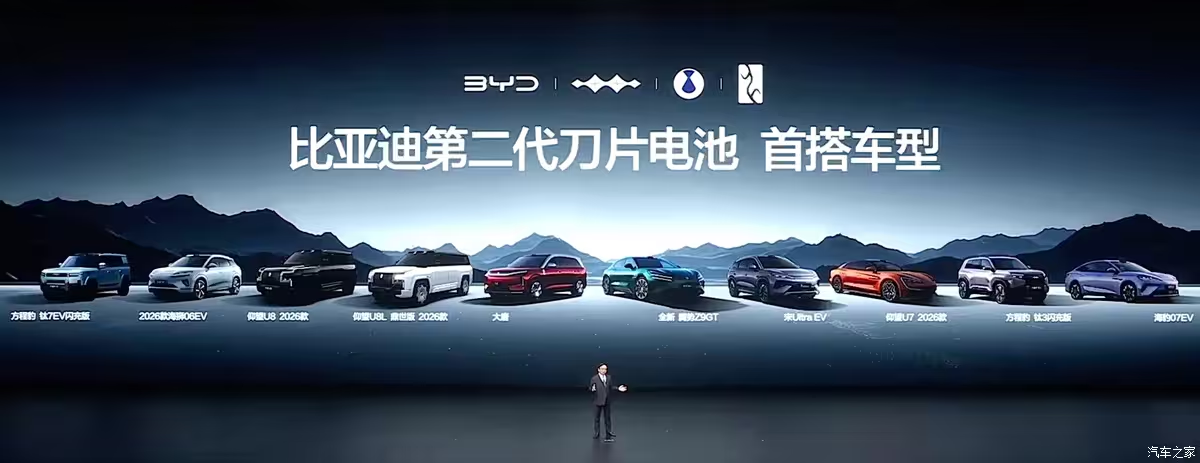

BYD claims 1,008 kilometers on its new flagship sedan. Nio says 1,050. Xiaomi’s SU7 claims 902. These are the kinds of figures that make a 300-mile Tesla Model 3 look almost modest, and as Chinese brands push harder into Europe, Southeast Asia, and Latin America, buyers outside China are starting to ask the obvious question: are these numbers even real?
The honest answer is yes, they’re just measured on a different scale. Nearly every one of those headline figures comes from CLTC, China’s domestic test cycle, and CLTC happens to be the most generous range rating on the planet. That’s not automakers lying to anyone. It’s a different yardstick, built around Chinese urban driving patterns rather than a German autobahn or an American interstate.
Once you understand how CLTC vs WLTP vs EPA actually differ, and how to translate between them, the real leaderboard of which Chinese EV goes furthest looks quite different from the press release.
Three Tests, Three Very Different Stories

CLTC
CLTC, the China Light-Duty Vehicle Test Cycle, replaced the older NEDC standard and was built to mirror how people actually drive through dense, congested Chinese cities. That’s also its weakness as a global yardstick. The cycle averages under 29 km/h across its full run, tops out around 114 km/h (well under any real expressway speed), and spends close to a quarter of its runtime sitting completely still. For a gasoline car, none of that matters much. For an EV, it’s everything.
Aerodynamic drag scales dramatically with speed, so a car barely has to fight the air at 29 km/h, and every one of those stop-start idle moments gives regenerative braking a chance to claw energy back into the pack. CLTC essentially tests EVs under the exact conditions where they are most efficient, and it largely skips the conditions- sustained highway speed, cold weather, hard acceleration- where they struggle.
WLTP
WLTP, the Worldwide Harmonized Light Vehicles Test Procedure, is used by Europe and a growing list of other markets. It runs hotter and faster: average speed above 46 km/h, a top speed near 131 km/h, and mandatory use of climate control and onboard electronics during the run. It’s still a laboratory test conducted at a mild 23°C, so it stays somewhat optimistic, but it’s a meaningfully tougher test than CLTC.
EPA
Then there’s the EPA rating used in the United States, and it’s the outlier for a good reason. The EPA doesn’t just run a harder track; it also applies a built-in downward correction, roughly a 30 percent reduction, to its own raw laboratory figures.
Regulators added that adjustment specifically because early window sticker numbers didn’t match what owners actually experienced on the road. The result is the range figure that comes closest to what a typical driver sees day-to-day, in typical weather, in typical traffic.
Doing the Math
Cross-reference enough vehicles across all three standards and you’ll get a consistent pattern. WLTP figures typically land somewhere between 78 and 82 percent of a car’s CLTC number. EPA figures fall further, generally landing around 70 percent of CLTC, which also puts EPA roughly 10 to 15 percent below WLTP for the same car.
This is a statistical average pulled from dozens of vehicles tested under multiple standards, and any individual car can fall above or below the trend depending on its shape, weight, and drivetrain tuning. But as a way to translate a Chinese brochure number into something closer to a real-world Western driving experience, it holds up well enough to be genuinely useful.
The Rankings, Adjusted for Reality
Applying that conversion to eight of the most talked-about Chinese EVs on sale or newly revealed in 2026 produces a very different leaderboard than the one in the press releases. The pecking order barely shifts, since a flat conversion factor doesn’t reshuffle rank, but the gap between “brochure range” and “range you’d actually plan a road trip around” often runs to 300 kilometers or more.
| Model | Battery | CLTC Range (Official) | WLTP Estimate | EPA-Style Estimate |
|---|---|---|---|---|
| Nio ET7 (150 kWh pack) | Semi-solid-state NMC | 1,050 km | ~840 km | ~735 km |
| BYD Da Han RWD | 102.3 kWh LFP | 1,008 km | ~805 km | ~705 km |
| Xiaomi SU7 Pro (2026) | NMC, 752V architecture | 902 km | ~720 km | ~630 km |
| Zeekr 007 (2026) | 103 kWh NMC | 800 km | ~640 km | ~560 km |
| Xiaomi YU7 Pro | 96.3 kWh LFP | 770 km | ~615 km | ~540 km |
| XPeng P7+ | 74.9 kWh LFP | 725 km | ~580 km | ~508 km |
| BYD Han L RWD | 83.2 kWh LFP | 701 km | ~560 km | ~490 km |
| BYD Seagull / Dolphin Surf | 38.88 kWh LFP | 405 km | ~325 km | ~285 km |
CLTC figures are official manufacturer ratings for each model’s longest-range trim, almost always a single-motor, rear-drive configuration. WLTP and real-world columns are estimates based on the conversion ratios above, not independent test results, since most of these specific configurations haven’t yet been homologated outside China.
Where the Formula Breaks Down

Nio actually put its number to the test. In back-to-back range challenges in December 2023 and April 2024, Nio’s own team drove ET7 sedans fitted with the 150 kWh pack across three separate routes and covered between 1,044 and 1,070 kilometers before running dry, essentially matching the CLTC claim.
That sounds like proof CLTC isn’t so fanciful after all, until you look at how the runs were actually done: a relay of trained drivers holding a steady average of roughly 84 km/h, largely in assisted-driving mode, over 12 to 15 hours on the road. It’s a genuine result, and it’s also almost nothing like how a typical owner drives.
Push that same car to 120 km/h on a German autobahn, or run the air conditioning hard through a Guangzhou summer, and the number falls off fast. Worth noting too: the 150 kWh pack isn’t something most ET7 buyers actually own outright. Nio offers it as a battery-swap subscription rather than a standard fitment.

XPeng offers the opposite lesson, proof that some cars undershoot the rule of thumb. The P7+ carries an official CLTC rating of 725 km on its larger battery, and because XPeng already exports this car to dozens of countries, there’s no need to estimate its WLTP figure. The real, independently homologated number is 530 km, a ratio of about 73 percent rather than the 80 percent average. Nothing is wrong with the car. It simply shows that the conversion math is a population average, not a guarantee, and that body shape, weight, and drivetrain tuning still meaningfully affect the result from car to car.
Battery chemistry adds one more wrinkle. BYD’s two biggest numbers here, the Da Han and the Han L, both come from lithium iron phosphate (LFP) packs, which are heavier per kilowatt-hour than the nickel manganese cobalt (NMC) cells used in cars like the Zeekr 007 or Nio’s flagship pack.
BYD compensates by simply building bigger packs, over 100 kWh in the Da Han’s case, which is a perfectly legitimate way to buy range. It also means two cars showing an identical CLTC figure can be carrying very different amounts of actual onboard energy, and behaving differently the moment they leave the gentle conditions CLTC was built to simulate.
Not every brand is even playing this game. Li Auto built its entire lineup around sidestepping the range argument altogether, pairing a modest battery with a gasoline range extender so owners never have to think about CLTC versus EPA in the first place. It’s a reminder that “longest range” and “least range anxiety” aren’t always the same competition.
Editor’s Take
None of this makes CLTC numbers meaningless, and it doesn’t make these cars any less capable within the conditions the test simulates. It means the number on the window sticker needs to be translated depending on where and how the car will actually spend its life. In markets where Nio, XPeng, Zeekr, and BYD homologate cars locally, always trust the official WLTP figure over the CLTC figure.
In markets that don’t have that local rating yet, from Southeast Asia to the Gulf to Latin America, knock the CLTC number down by roughly 30 percent for a realistic expectation, and knock it down further in cold weather or at sustained highway speed. The best Chinese EVs on this list really are pushing the entire industry’s sense of what’s possible on a single charge. Just check which stopwatch was running when that number was set.

Hillary started his automotive writing journey at HotCars, and has written for CarNewsChina, GlobalSUV, and many other top auto blogs.
He loves to read, play chess, and supports Liverpool during the weekends