

British buyers registered 384 Chinese-built vehicles in 2015. Last year the figure was 285,000. Chinese brands now hold roughly 13 per cent of new UK car registrations, double their share from a year earlier, and BYD alone nearly doubled its own UK registrations in the first half of 2026, past 37,000 units.
This guide walks through how to buy a Chinese EV in the UK: why the market looks the way it does, how to pick the right badge and model for your life, and how to get through financing and paperwork without surprises.
Why the Flood, and Why Britain Specifically
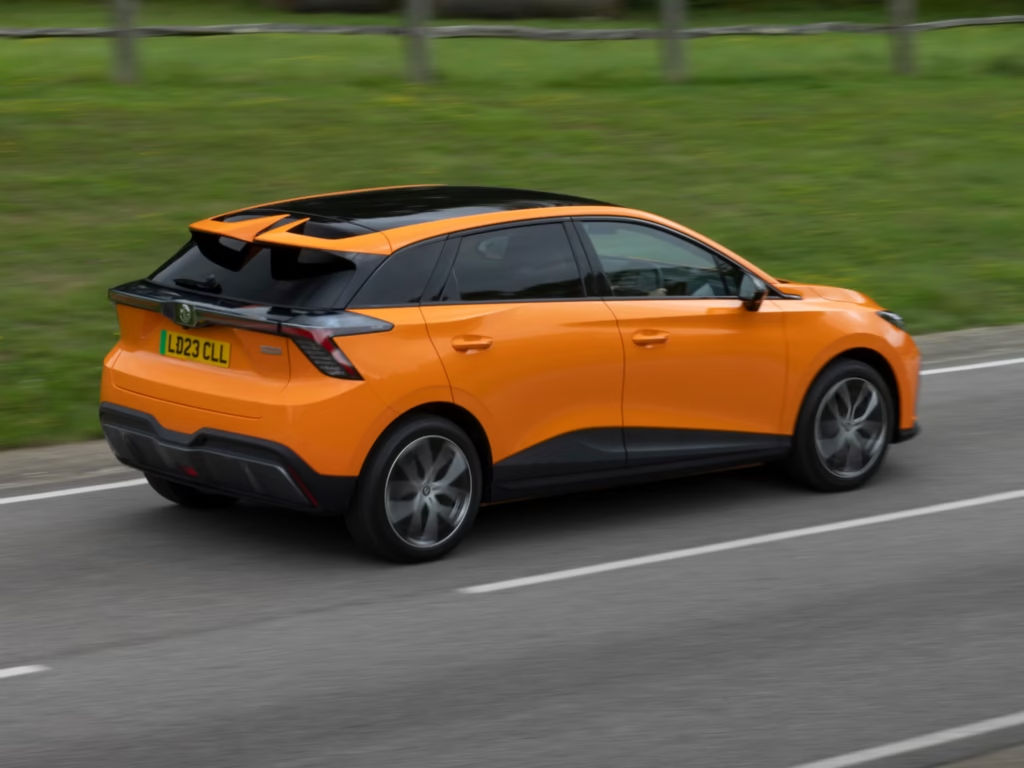
Understanding why matters, because it explains almost everything else in this guide, including the prices.
The short version is tariffs, or rather their absence. Brussels charges anti-subsidy duties on top of its standard import tariff, roughly 17 per cent for BYD, 18.8 per cent for Geely, and 35.3 per cent for SAIC, the parent of MG. Washington charges a flat 100 per cent. London charges neither. A UK version of the EU-style duty was drawn up and then quietly shelved.
The effect on price is not subtle. A German-built Volkswagen Tiguan plug-in hybrid sells in Britain for a little over £43,000. A comparable BYD Seal U, built in China, costs close to £10,000 less. That gap, repeated across dozens of model pairings, is most of this story in miniature.
Two other forces point the same way. China’s domestic market is cooling hard: retail sales are down roughly a quarter in the first half of 2026, even as exports rose more than 70 per cent, per the China Association of Automobile Manufacturers, so manufacturers with spare capacity need somewhere to send the cars. And Britain’s own Zero Emission Vehicle mandate requires a third of every manufacturer’s 2026 sales to be zero emission, or it triggers fines of up to £15,000 per car short of target, a mandate now under review for future years even as 2026’s figure stands.
None of this makes a Chinese EV a poor choice. It means the value on offer right now is partly a function of policy, not just engineering, worth remembering by the end of this guide.
Know Your Badges

MG is the elder statesman here. Chinese-owned since SAIC bought the marque in 2007, it has spent nearly two decades rebuilding a name Britain already trusted rather than launching something new, exactly why its dealer network is the most mature on this list.
BYD is the heavyweight: the world’s largest EV manufacturer by volume, building its own Blade LFP battery cells in-house rather than buying them in, and turning that vertical integration into some of the sharpest pricing in the segment.
Chery arrived only in 2024 and has scaled faster than almost any brand in recent UK history, mostly through its Omoda and Jaecoo sub-brands. Jaecoo became Britain’s fastest-growing brand in 2025 on the back of the rugged Jaecoo 7, while Omoda plays a softer, lifestyle-focused game across the 5, 7, and flagship 9, most of which are available as both full EVs and plug-in “Super Hybrid” models.

GWM’s approach has been quieter. Ora brings a distinctive, slightly retro design to the small hatchback class, badged as the Ora 03, while Wey covers the more premium SUV end, though volumes for both remain modest compared to BYD or MG.
Leapmotor’s route in is worth knowing on its own terms. It arrived through a partnership with Stellantis, so Leapmotor cars are sold and serviced through the existing Vauxhall dealer network. This real advantage lets a young brand skip the years most newcomers spend building service coverage from scratch.
Xpeng launched full UK operations in early 2026, deliberately positioning itself upmarket around fast charging and driver-assistance software rather than bargain pricing. The flagship G6 claims roughly 10 to 80 per cent charging in around 12 minutes, with suspension Xpeng says has been reworked for British roads specifically, a claim only a proper test drive really settles.
Geely sits apart from this list. It owns Volvo, Polestar and Lotus outright, but all three are marketed as European brands, so anyone shopping for a Chinese badge is unlikely to end up looking at a Geely one directly.
Match the Metal to Your Actual Life
Work out your real daily mileage, whether home charging is realistic for you, and your actual budget including insurance, before a spec sheet talks you into more range or tech than you’ll ever use.
- Budget city runabout: the Leapmotor T03 and BYD Dolphin Surf both undercut £19,000, the cheapest realistic route into a new electric car in Britain right now. Fine for short commutes, less fine if motorway range anxiety is a real concern.
- Mainstream family EV: the MG4 EV and newer MG S5 EV sit in the high twenties, going head-to-head with the Volkswagen ID.3 and usually beating it on standard equipment.
- Family SUVs that won’t feel cramped: the BYD Atto 3, Omoda E5, and roomy Leapmotor C10 cover the compact SUV space, dominating UK sales charts, typically priced at £30,000 to £36,000.
- Tech-forward, willing to pay for it: the Xpeng G6 stands out, built around rapid DC charging and a striking coupe-SUV silhouette, from around £40,000.
- Not ready to give up petrol entirely: the Jaecoo 7 PHEV, Omoda 9 PHEV and BYD Seal U DM-i all pair a decent electric-only range with a combustion engine for longer trips, a sensible middle ground if home charging isn’t reliably available.
Safety Is Settled, Warranty Is Where They Actually Compete

Doubts about whether a bargain price means a compromise on safety have largely been settled by independent testing. The BYD Seal, BYD Atto 3, Xpeng G6 and MG4 EV have all taken five-star Euro NCAP ratings, and every Chinese EV sold through an authorised UK dealer must clear the same Whole Vehicle Type Approval process as any Ford or Toyota. That’s a legal condition of sale, not a marketing claim.
Where these brands actually differentiate themselves is in warranty length, and they’re using it deliberately to build trust in a market still getting used to unfamiliar names. BYD backs its cars with seven years or 100,000 miles on the vehicle and eight years or 125,000 miles on the battery.
MG, Omoda and Jaecoo all offer broadly comparable seven-year cover. Set that against the three to five years still standard for most European and Japanese manufacturers, and it’s a meaningful gap, particularly for anyone keeping a car long-term or wary of battery degradation.
Read the small print before committing to a specific model. Not every warranty transfers cleanly to a second owner, and that detail matters more for resale value than most buyers realise until they’re the ones trying to sell.
Book the Test Drive, and Mean It
With several brands still building out coverage, dealer availability outside major cities can be patchy. Phone ahead rather than turning up on spec, since demonstrator cars are sometimes limited to a single flagship trim that doesn’t reflect what you’d actually drive away in.
Pay attention to three things no spec sheet tells you. Infotainment usability varies enormously; some brands pair excellent screens with confusing menu logic. Ride quality on actual UK roads matters more than any manufacturer’s claims about bespoke suspension tuning, so judge it yourself rather than taking a press release’s word for it. And build quality, panel gaps, and interior material feel still vary more between these newer entrants than between established European rivals, even as that gap closes fast.
Work Out How You’re Paying For It
Most buyers finance rather than pay cash, so understand the options early, since they can point you toward an entirely different shortlist.
- PCP: the lowest monthly payments, with a balloon payment due at the end if you want to keep the car outright.
- HP: higher monthly payments, but the car is yours at the end with no balloon gamble on future value.
- Salary sacrifice: where your employer offers it, currently the cheapest realistic way to drive a new Chinese EV, stacking income tax and National Insurance savings on top of an already competitive base price.
- Cash: increasingly common at the budget end, where cars like the Dolphin Surf and T03 are cheap enough that plenty of buyers skip financing altogether.
One useful, less obvious tip: manufacturers under Zero Emission Vehicle mandate pressure tend to discount hardest towards the end of a compliance period, racing to hit their required share of electric sales before certificates are counted. Ask your dealer where they stand against target. It can move the price by several hundred pounds.
Residual values are also worth interrogating with newer brands specifically, simply because there aren’t years of resale data to draw on. That uncertainty feeds straight into PCP balloon figures and lease pricing, so ask how your specific model’s projected residual was actually calculated, rather than assuming it’s reliable.
Charging and the Real Cost of Ownership

If you can charge at home, get a wallbox quoted and booked before delivery day, not after. Installation queues can run several weeks in busy periods, and a month on a three-pin plug is a rough way to start EV ownership.
If you’re relying on public charging, check the car’s actual maximum DC charging speed rather than the headline range figure, since that determines how painless a motorway stop feels. The Xpeng G6 sits near the top of the segment here, while some budget models charge considerably slower.
Beyond the purchase price, you have to factor in the real cost of owning a Chinese car in the UK. Budget for insurance (premiums can run higher on less common models simply because insurers have thinner claims data to price against), servicing reach (a brand with a wide network like MG or BYD is generally cheaper to keep serviced than one still building coverage out), and parts availability, worth asking your dealer about directly.
Vehicle Excise Duty and any local low-emission zone benefits apply the same way to a Chinese-made EV as to any other, though it’s worth confirming current rates at the point of purchase.
Negotiate, Then Do the Paperwork Properly
Brands still chasing UK volume are often more willing to move on price or to throw in extras like charging cables and servicing packages than manufacturers with decades of pricing discipline behind them. It costs nothing to ask.
Once the terms are agreed, the paperwork is identical to that for buying any new car in Britain. Confirm the on-the-road price includes registration and plates, read any finance agreement line by line, and make sure warranty documentation is issued in your own name at handover.
Editor’s Take
The safety data holds up under independent scrutiny. The warranties outclass most established rivals. Dealer networks that looked thin two years ago are catching up fast, quarter by quarter.
Still, hold onto the earlier context. A meaningful part of the value on offer exists because Britain hasn’t erected the tariff wall that Brussels and Washington both have, and trade policy is not a fixed law of physics. Brussels is already exploring a minimum-pricing system as an alternative to its current duties, and there’s no guarantee Britain’s own approach will stay exactly where it is either.
Buy the car that actually fits how you live and drive, not the discount that happens to exist this particular year. For a fast-growing number of British buyers, it still makes sense on those terms, and that’s a genuinely different market than the one selling curiosities three years ago.

Hillary started his automotive writing journey at HotCars, and has written for CarNewsChina, GlobalSUV, and many other top auto blogs.
He loves to read, play chess, and supports Liverpool during the weekends


