
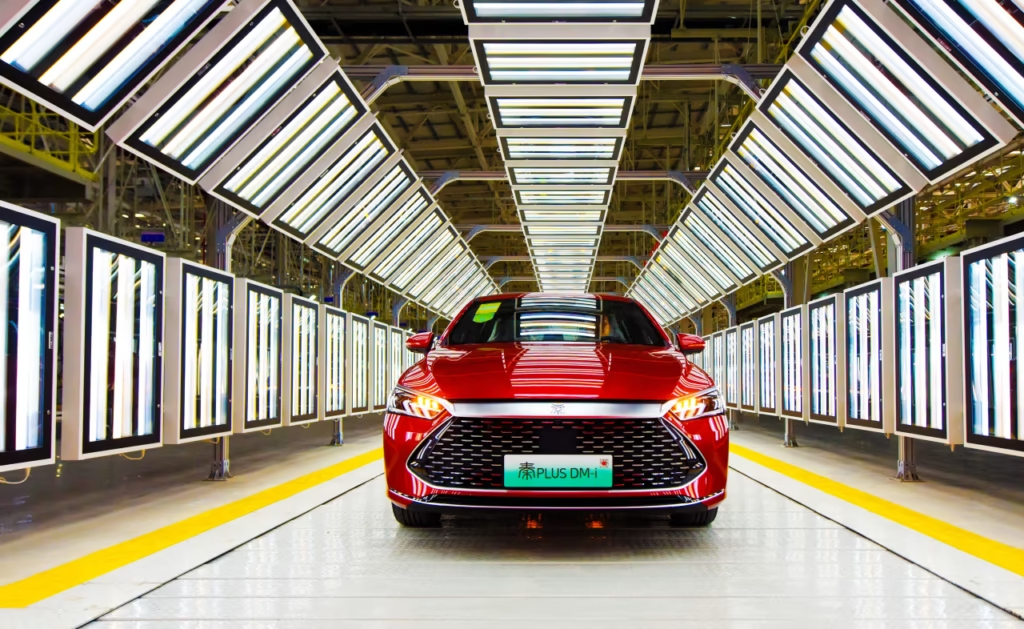
In the first quarter of 2025, the average battery electric vehicle sold in China cost $25,465, roughly 3% less than the average petrol car in the same market, according to data from automotive analytics firm Jato. In Germany, in the same period, the average EV cost $63,837, compared with $47,558 for a petrol car, a 34% premium. In the United States, the gap was 31%. The same technology, produced at an industrial scale, costs 2.5 times as much in Germany as in China. That is not a rounding error, and the standard explanation — Chinese government subsidies — is almost entirely wrong.
In February 2026, the Rhodium Group, a New York-based independent research firm, published what is currently the most rigorous quantitative analysis of the cost gap between Chinese and Western EV manufacturers. Their methodology compared BYD, Geely and Leapmotor against Tesla’s China operations on a per-vehicle basis, controlling for market position and model type. The finding that has circulated most widely from that report: Chinese state subsidies account for approximately 5% of BYD’s cost advantage over Tesla. The remaining 95% comes from structural factors that have nothing to do with government support, and everything to do with how Chinese manufacturers have built their businesses.
Here, we tackle those structural factors one by one. Not because subsidies are irrelevant — they are not — but because focusing on subsidies as the primary explanation has led politicians and consumers in Western markets to fundamentally misunderstand the problem they are looking at. Tariffs can offset subsidies. They cannot offset vertical integration, 18-month development cycles, or a supply chain cluster where every component needed to build an EV is within 200 miles of the factory.
BYD’s $4,700 Cost Advantage Over Tesla, Broken Down
The Rhodium Group calculated that BYD has a per-vehicle cost advantage of approximately $4,700 over Tesla when both are producing in China. Here is where that $4,700 comes from:
Per-vehicle cost advantage: BYD vs Tesla China operations
| Cost factor | BYD advantage / vehicle | Share of total gap |
| Vertical integration (in-house manufacturing) | ~$2,100 | Largest single factor |
| Lower R&D and SG&A overhead costs | ~$1,100 | Second largest factor |
| Supplier payment float (extended payment terms) | ~$214 | ~5% of total gap |
| Preferential financing (below-market borrowing) | ~$12 | < 1% of total gap |
| Direct government grants | ~$292 | ~6% of total gap |
| TOTAL estimated advantage | ~$4,700 | 100% |
Source: Rhodium Group, ‘Why Are Chinese EVs So Cheap?’, February 19, 2026. Figures are estimates based on disclosed financials and bill-of-materials analysis. Some individual line items are JustChinaCars.com approximations from the Rhodium data; the total $4,700 figure and the 5% subsidy share are directly from the report.
The subsidies account for roughly $292 per vehicle in direct grants and $12 in preferential financing: approximately $304 total, or around 6% of the gap. The structural advantages account for the other $4,396. This is not a dismissal of the subsidy argument. $292 per vehicle across four million annual sales is over $1 billion. But it is a precise characterization of how much the structural factors outweigh the political ones.
Vertical Integration: Building the Factory Inside the Factory

The single most important structural cost advantage Chinese manufacturers hold is vertical integration, the practice of manufacturing components in-house rather than purchasing them from external suppliers. The Rhodium Group identifies this as the primary driver of the cost gap, and the numbers make the argument clearly.
A UBS bill-of-materials study found that 75% of the BYD Seal is manufactured in-house, compared with 46% for the Tesla Model 3 and just 35% for the Volkswagen ID.3. Rhodium’s own analysis estimates BYD manufactures around 80% of Tier 1 components and roughly 36% of Tier 2 components internally, more than twice Tesla’s in-house share of Tier 1 components at 37%. BYD makes its own batteries, its own electric motors, its own power electronics, its own silicon carbide chips (introduced on the Super e-Platform in 2026), its own seats, its own glass and it even owns lithium mining assets.
Why does this reduce cost? Three reasons. First, the supplier margin disappears. Every component BYD produces in-house is sold to itself at cost rather than at a supplier’s margin. Second, the negotiating dynamic changes: a manufacturer that can credibly threaten to bring any component in-house has significantly more leverage over external suppliers on the components it does purchase. Third, the innovation cycle compresses: when the battery engineers and the vehicle engineers share a building, modifications that would require a multi-month supplier negotiation in a Western OEM can be resolved in a meeting.
This is not universally true across Chinese manufacturers. Rhodium is explicit on this point: BYD and Leapmotor are outliers even within China. Leapmotor reportedly produces 60–70% of its components in-house. Most other Chinese OEMs are far more conventionally structured, and their cost advantages are correspondingly smaller. The lesson is not that all Chinese manufacturers are vertically integrated, it is that the ones maintaining the largest and most durable price advantages are the most vertically integrated ones.
Western OEMs made the opposite bet in the 1990s. GM spun off Delphi. Ford spun off Visteon. The logic was cash-flow efficiency — let specialists own the capital. The consequence, thirty years later, is structural dependence on a supplier ecosystem that Chinese competitors have partially bypassed.
Cheaper R&D and Overhead — and Counterintuitive Productivity

The second major structural advantage is lower research, development, selling and administrative costs per vehicle, and the mechanism behind it is more complex than it first appears.
Chinese engineers are paid significantly less than their counterparts in Germany, the United States or Japan. This is well-documented and genuinely contributes to lower R&D spend per vehicle. But the salary gap alone does not explain the full R&D cost advantage. What compounds it is the development cycle. Western OEMs typically take four to five years, and in some cases up to seven, to bring a new model from concept to production. Leading Chinese OEMs have compressed that cycle to 18 months. Arthur D. Little, in its January 2026 China Speed report, estimated that Chinese brands launched 388 new passenger car models between 2023 and 2025. In 2025 alone, the top 19 Chinese OEMs revealed 87 all-new vehicles, 4.6 per company. Japanese brands produced 34 new models in the same year; European brands 28; American brands 12.
A shorter development cycle means the R&D cost per vehicle is spread over fewer months of salaries, fewer prototypes, fewer facilities and fewer approval rounds. It also means the vehicle reaches the market while the technology is still current. A Chinese manufacturer that conceives a car in January 2025 and launches it in July 2026 is selling contemporary technology. A Western manufacturer beginning the same process in January 2025 and launching in 2029 is selling technology conceived four years earlier.
One counterintuitive finding from the Rhodium report deserves prominent mention: Western OEMs are actually more productive than Chinese ones by conventional metrics. Tesla generates roughly six to seven times more revenue per employee than BYD. Volkswagen outperforms China’s largest OEMs similarly. This appears paradoxical until you understand that BYD’s lower revenue-per-employee figure reflects its vertical integration. It has a larger workforce because it manufactures components that Western OEMs purchase externally. More employees doing more work in-house does not make BYD less efficient; it makes its revenue-per-employee figure look lower while its cost-per-vehicle is lower. The productivity metric measures the wrong thing.
The Supply Chain Cluster: 200 Miles to Everything
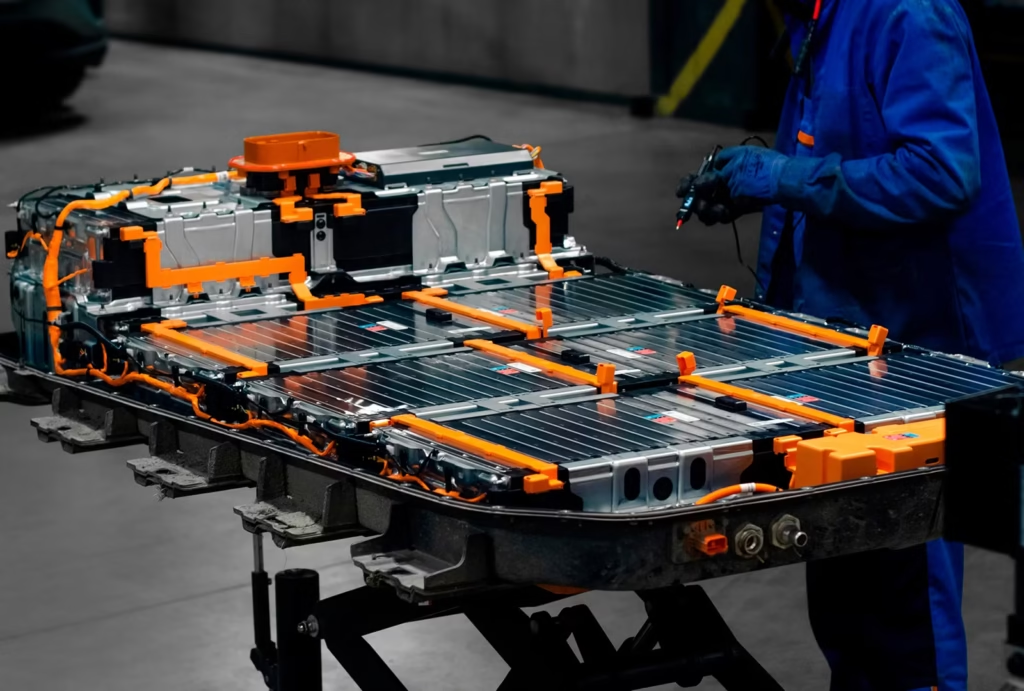
There is a geographic dimension to the Chinese cost advantage that is easy to underestimate because it does not show up as a line item on a balance sheet. In China’s Yangtze River Delta, the region spanning Shanghai, Jiangsu, Zhejiang and parts of Anhui, an EV manufacturer can typically find every component needed to build a vehicle within a 200-mile radius. Battery cells, cathode materials, power electronics, motors, seats, glass, tires, charging systems, software development talent; all of it is within a two-to-three-hour drive. Leapmotor’s Hangzhou Bay research hub, for instance, operates around the clock; engineers iterate on components and can have revised physical parts delivered from nearby suppliers the same day.
This proximity achieves several cost reductions simultaneously. Logistics costs are lower. Lead times for prototyping are shorter. Communication between OEM engineers and supplier engineers, which at a Western manufacturer might involve international travel, time zone gaps and translation, happens face-to-face within hours. Quality issues can be investigated at the source rather than diagnosed remotely. And critically, a new EV startup with a software background but limited manufacturing experience can launch a vehicle because the entire manufacturing ecosystem it needs exists within commuting distance. This is not something that can be replicated through policy in the short term.
The Yangtze River Delta cluster represents decades of accumulated industrial investment and supplier relationships. The US and EU are both attempting to build alternative supply chains. The Inflation Reduction Act’s battery manufacturing credits and the EU’s Net-Zero Industry Act are both partly aimed at this, but analysts estimate the US would need to invest approximately $87 billion and Europe approximately $102 billion to build fully localised supply chains by 2030. Even at that investment level, the cluster density that China has built organically over twenty years cannot be manufactured by policy in a decade.
Competition So Intense It Became Its Own Cost Reduction Tool

The domestic Chinese EV market is the most competitive automotive market in the world by almost any measure. EVs now represent over 50% of new car sales in China. More than 130 electric vehicle models were available in 2024. The price war that ran from 2022 through 2025 was so severe that China’s State Administration for Market Regulation issued a ruling in February 2026 banning vehicle manufacturers from selling below manufacturing cost, an unprecedented intervention designed to prevent several manufacturers from being pushed into bankruptcy by competitors selling at losses to gain share.
What this competition produced, over five years, was a systematic compression of costs and a systematic expansion of standard equipment. BYD cut the price of the Seal from $30,198 in 2022 to $24,190 by the end of 2025 — a 20% reduction — while the Tesla Model 3 barely moved from $32,909 to $32,688 despite Tesla manufacturing locally in Shanghai. Every manufacturer that survived the price war did so by finding costs to remove, features to add at the same price, or technologies to scale faster. The ones that could not were either acquired or went bankrupt.
The survivors emerged with production processes hardened by years of margin pressure that Western competitors have not experienced in the same form. A German or American manufacturer competing in a home market where EVs carry a 31-34% price premium over ICE vehicles faces fundamentally different competitive pressure than a Chinese manufacturer competing in a market where EVs are 3% cheaper than ICE and where fifty credible competitors are trying to undercut them every model cycle.
What Subsidies Actually Do — and Don’t Do

It would be wrong to dismiss subsidies entirely, and this article does not attempt to. BYD received approximately $1.4 billion in government grants in 2024. That figure accounted for 35% of its net income. SAIC received $730 million; Geely $113 million. These sums are real, and they do provide competitive support.
What they do not do is explain the fundamental price gap. When Rhodium spreads BYD’s $1.4 billion in grants across its four million annual vehicle sales, the per-vehicle advantage works out to approximately $292, a small fraction of the $4,700 gap. And crucially, this is the gap between BYD and Tesla China, not between BYD in China and Volkswagen in Germany. When you add the cost of manufacturing in high-wage, high-regulatory Western markets, the gap widens substantially before subsidies become relevant.
The subsidy narrative also suffers from selective memory. Tesla received $251 million in Chinese cash grants between 2019 and 2022, plus at least $39 million in assets and services, support that partly funded the Shanghai Gigafactory that now makes Tesla’s most competitive vehicles. BMW and Volkswagen both cite Chinese government subsidies as drivers of their China investment decisions. The difference is not that Western manufacturers receive no Chinese state support; it is that Chinese OEMs receive substantially more.
Closing the cost gap would require Western OEMs to invest more deeply in China to build local R&D and supplier ties, while cutting costs and jobs at home — a strategy that increasingly puts automakers at odds with Western governments whose industrial policies are geared toward protecting domestic auto employment. — Rhodium Group, February 2026
What the Price Gap Looks Like in Practice
Direct price comparison: comparable Chinese and Western EVs, international markets (2026)
| Model | Segment | China price (USD) | Europe price (USD) | Price gap |
| BYD Seal (Atto 4) | Mid sedan | ~$24,200 | ~$38,000 | ~57% premium in EU |
| Tesla Model 3 | Mid sedan | ~$32,700 | ~$42,000 | ~28% premium in EU |
| BYD Atto 3 (Atto) | Compact SUV | ~$22,500 | ~$35,000 | ~56% premium in EU |
| Volkswagen ID.4 | Compact SUV | ~$26,000 (China) | ~$47,000 | ~81% premium in EU |
| BYD Seagull (Dolphin Mini) | City car | ~$10,000 | ~$25,000 | ~150% premium in EU |
| Renault 5 E-Tech | City car | N/A (not sold in China) | ~$28,000 | Western city car baseline |
Prices are approximate and reflect base trims. European prices include local VAT and registration costs but exclude tariffs on Chinese vehicles where applicable. Sources: manufacturer pricing, CarNewsChina, Jato Dynamics Q1 2025 data. EU tariffs of 17–45% on Chinese EVs (depending on brand) are not reflected in the ‘Europe price’ column for Chinese brands, as many are manufactured or sourced to avoid them.
Can Western Manufacturers Close the Gap?
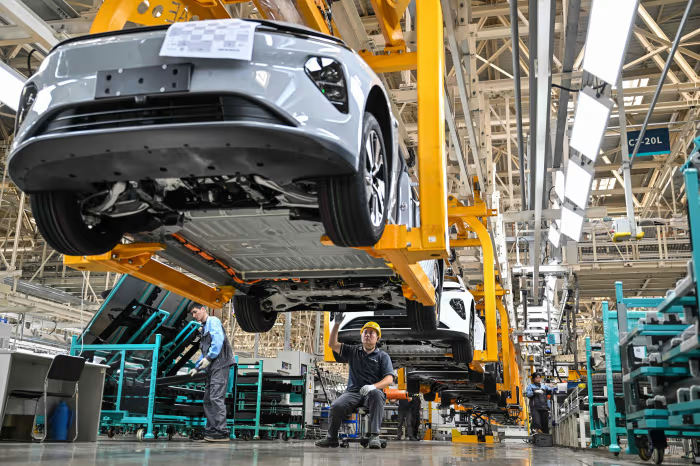
The honest answer, based on the available evidence, is: partially, slowly, and at significant political cost.
The development cycle gap is narrowing. Renault has reportedly targeted a 16-month development cycle using its Shanghai tech center. Volkswagen’s partnership with Xpeng is partly aimed at accessing Chinese software development speed. Toyota described the pace of development at its planned Shanghai Lexus plant as ‘Shanghai speed’, a deliberate admission that the new benchmark is set in China, not Stuttgart or Detroit. These are real adaptations, but they are adaptations to where China was eighteen to twenty-four months ago, not where it is going. The Arthur D. Little January 2026 China Speed report notes that Chinese brands launched 388 new models between 2023 and 2025 — a rate of new product introduction that Western manufacturers cannot currently match and are not on a trajectory to match within this decade.
The vertical integration gap is harder still. Western OEMs outsourced their component manufacturing for over 30 years, creating a deep structural dependence on supplier networks. Reversing that would mean renegotiating or terminating contracts with suppliers that employ hundreds of thousands of people in their home markets, a politically untenable proposition for most governments. As Rhodium summarises, closing the cost gap requires investing more deeply in China while simultaneously cutting costs and jobs at home. Both of those things put manufacturers directly at odds with their home governments’ industrial policies.
The supply chain geography gap cannot be closed by any individual manufacturer’s decision. It requires a generation of policy support, industrial investment, and supplier development to create a cluster in the EU or US that approaches the density of the Yangtze River Delta. And the evidence from the IRA and the EU’s own battery investment programs is that this is achievable in specific segments (battery cells, particularly) but not across the full vehicle supply chain within a ten-year horizon.
What this means in practice is that the price premium on EVs in Western markets is structural and durable. It will compress over time as Western manufacturers adapt, as supply chains partially localize, and as Chinese manufacturers’ costs rise as they scale internationally. But the idea that tariffs can restore competitive equilibrium between Chinese and Western manufacturers is not supported by the data. Tariffs can protect market share in the short term. They cannot change the underlying cost structure of manufacturing a car in Wolfsburg versus Shenzhen.
Editor’s Take
The Rhodium Group report is, to our knowledge, the most rigorous quantification of this cost gap published to date, and its finding that subsidies account for just 5–6% of the advantage deserves to reshape the policy conversation in Europe and North America. It almost certainly will not, because ‘structural competitive advantages built over two decades’ is harder to legislate against than ‘unfair state subsidies.’ But for buyers making purchase decisions, and for journalists trying to explain why a BYD Seal costs $24,200 in China and a comparable German EV costs $47,000 in Germany, the Rhodium analysis is the most accurate framework available.
One caveat worth noting: the report compares BYD and Tesla in China, which is the cleanest possible comparison — same country, same regulatory environment, same consumer market. The gap between BYD in China and Volkswagen in Germany is substantially larger because it adds the cost difference between manufacturing in China and Germany to the structural advantages. The $4,700 figure is a floor, not a ceiling.
For buyers in markets where Chinese EVs are available — and the list is growing, with BYD, MG, Nio, Zeekr, Chery, and other Chinese EVs now selling across Europe, Australia, and Southeast Asia — the practical implication is straightforward: the price difference is not a quality discount or a safety compromise. It is the product of a manufacturing system built on different structural foundations, sharpened by competition so fierce that China’s own government had to intervene to stop manufacturers from selling below cost. The car is cheaper because the system that built it is genuinely structurally more cost-efficient, not because someone in Beijing wrote a cheque.
Sources: Rhodium Group, Visual Capitalist

Hillary started his automotive writing journey at HotCars, and has written for CarNewsChina, GlobalSUV, and many other top auto blogs.
He loves to read, play chess, and supports Liverpool during the weekends


