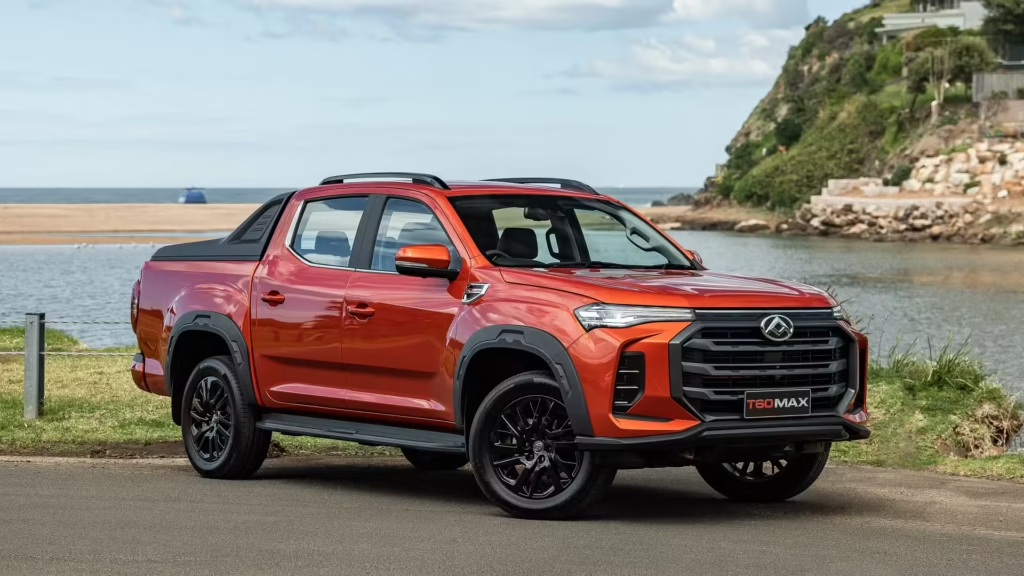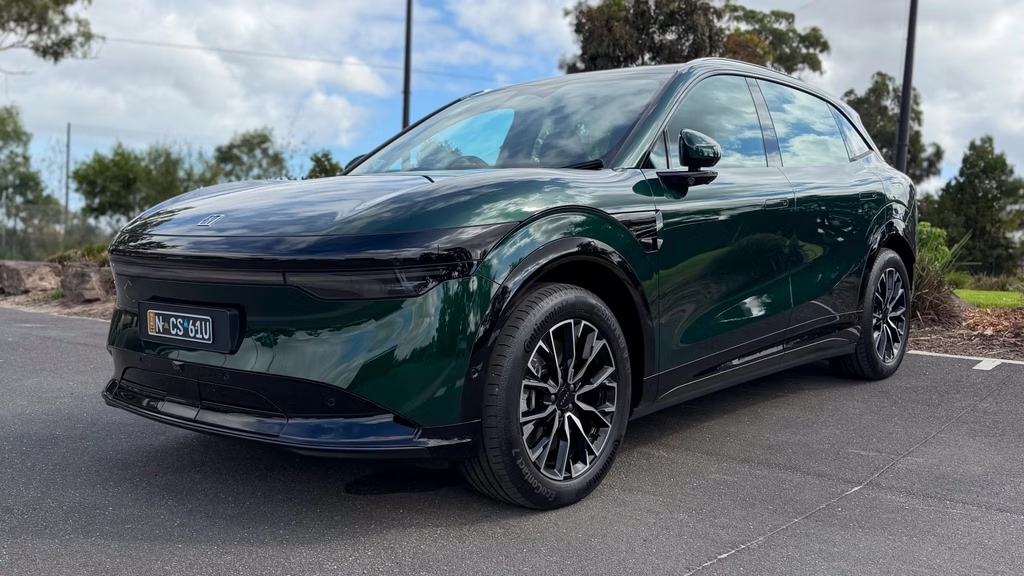

A stretch of Inner Mongolia called Yakeshi turns into one of the most punishing proving grounds in the global auto industry every December. That is where Autohome sent a fleet of 67 new-energy vehicles and put nearly 100 engineers to work running 7 separate tests: range, energy consumption, fast charging, cabin heating, automatic emergency braking, acceleration, and off-road grip.
The results, published in late December 2025, gave the clearest answer yet to a question that keeps many would-be EV buyers hesitant. How do Chinese cars and cold weather relate, and does all that advertised range evaporate the moment the thermometer drops? We break down all of that and a lot more here.
Chinese Cars and Cold Weather

The short answer is that Chinese cars perform considerably better than they did a few years ago, and still noticeably worse than the window sticker promises. In the headline range test, the Xpeng P7 in All Wheel Drive form came out on top, retaining 53.9 percent of its claimed CLTC range (China’s own testing cycle, generally recognized as more generous than the WLTP figures used in Europe).
BYD’s Yangwang U7 followed at 51.8 percent, with the Zeekr 001 close behind at 49.6 percent. Even the winner, in other words, lost close to half its advertised range to the cold. Further down the leaderboard, the Tesla Model Y placed 31st at 35.2 percent, and the lowest score of the entire test belonged to the Li Auto i8 at 34.8 percent, a detail with some bite to it since Autohome’s founder, Li Xiang, is also Li Auto’s chief executive. If anything, that result argues for the test’s credibility rather than against it.
Energy consumption told a more predictable story. Smaller, lighter cars sipped power more carefully than anything else on the ice, with the BYD Seagull leading at 23.5 kWh per 100 km, the Geely Xingyuan a close second, and the BYD Seal 06 rounding out the podium. Fast charging produced its own surprises.
The Avatr 06 needed just 15 minutes to go from 30 to 80 percent, ahead of the Nevo 06 and the Fulwin A9L, an extended-range EV that shared the podium with two pure electrics. Xiaomi’s YU7 SUV took 31 minutes for the same charge, landing 39th, while the Tesla Model Y took 35 minutes, landing 44th. Xiaomi’s SU7 sedan, notably, sat this particular test out entirely.
Why Cold Breaks Lithium

None of this is really a Chinese engineering failure so much as a lithium problem that Chinese brands run into more often than most. The battery chemistry that dominates the domestic market, lithium iron phosphate (LFP), is simply more cold-sensitive than the nickel manganese cobalt (NMC) chemistry favored by many Western and Korean rivals.
Inside an NMC cell, lithium ions move through a layered crystal structure that stays relatively open even as temperatures fall. LFP ions travel through a tighter, maze-like olivine structure that gets considerably harder to navigate in the cold, since the electrolyte thickens and internal resistance climbs faster than it does in NMC packs. Engineers generally cite NMC cells retaining around 70 to 80 percent of room-temperature capacity at -20°C, compared with roughly 60 to 70 percent for LFP.
Chemistry is only half the story, too. The single biggest drain on winter range in almost any EV is cabin heating, since electric cars have no waste engine heat to recycle the way a combustion car does. Older systems rely on resistive PTC heaters that draw power straight from the battery, a brute-force solution at best.

Heat pumps, now standard or optional on most competitive Chinese models, operate more like a reversed refrigerator, extracting ambient heat rather than generating it from scratch, and they meaningfully cut the winter energy penalty. Norwegian testing group NAF’s most recent winter comparison found heat pump-equipped EVs losing an average of around 18.5 percent of range at -10°C, against roughly 31 percent for cars still relying on PTC heaters alone. That gap explains why heat pumps have quietly become one of the more consequential lines on a modern EV spec sheet.
The Cold Charging Arms Race
The real drama right now is in charging speed, and BYD has staged the most theatrical demonstration of it. In March 2026, chairman Wang Chuanfu unveiled the second-generation Blade Battery alongside a new Flash Charging system built on a 1,000-volt architecture capable of 1,500 kW peak output, roughly three times the peak of Tesla’s latest V4 Supercharger.
BYD’s Blade Battery

To prove its cold-weather claims, BYD left a Denza Z9GT in a chamber at -30°C for a full 24 hours, then hooked it up to a Flash Charger on camera. The battery went from 20 to 97 percent in 12 minutes, only three minutes slower than the same charge at room temperature, and BYD says the pack retains more than 85 percent of its capacity at -20°C thanks to an active refrigerant system that heats and cools the cells on demand.
Wang framed slow charging and poor cold-weather performance as the last two real barriers to mass EV adoption, and BYD is backing that claim with plans to build 20,000 flash-charging stations across China by the end of 2026. Heat pumps, meanwhile, now come standard on export-focused models like the Atto 3, Seal, and Dolphin.
CATL’s Sodium-ion Battery

CATL is placing an entirely different bet. Rather than trying to out-engineer LFP’s cold weaknesses, the world’s largest battery maker is pushing sodium ion chemistry into production under its Naxtra brand, rated to operate between -40°C and 70°C and said to retain around 90 percent of its capacity at -40°C. CATL and Changan plan to put the first mass-production sodium-ion passenger car on sale in China by the middle of 2026.
Gotion High Tech is chasing similar territory from a third angle, its G Battery paired with Changan’s Qiyuan A06 reportedly surviving 24 hours of frozen outdoor storage before adding 200 km of range in six minutes on an 800-volt platform. None of this is a coincidence. Northeast China and Inner Mongolia, where winters regularly fall to -30°C or -40°C, have effectively become the industry’s shared testing ground, the place every major battery maker now has to prove itself before claiming any kind of cold weather crown.
Nio Swap Stations Sidestep the Problem

Nio took a different route altogether, one that avoids cold weather charging physics rather than trying to beat them. Instead of waiting for a frozen pack to warm up enough to accept a fast charge, a Nio driver pulls into a Power Swap Station and has the depleted battery mechanically removed and replaced with a pre-warmed one in under five minutes, regardless of the temperature outside, because the station’s spare batteries sit in temperature-controlled bays the whole time.
It is part of why Nio picked Norway, of all places, as its first market outside China back in 2021: a brutal winter proving ground that doubled as a showcase. The strategy has scaled impressively at home. Nio passed 100 million total battery swaps in February 2026 and now runs close to 3,800 stations worldwide. Its European rollout has been far more modest, stuck around 60 stations after nearly five years despite splashier targets floated earlier in 2026, and chief executive William Li has said Europe will not be a real priority again until 2028 given how competitive the market has become there.
Why It Matters Beyond China

None of this is an abstract, purely domestic concern. Norway has spent a decade as the world’s most demanding EV proving ground, and Norwegian drivers even have a word for the anxiety that sets in on a subzero morning: rekkevideangst, or range anxiety. The rough rule of thumb Norwegian engineers cite lines up almost exactly with what Autohome found outside Yakeshi.
A frost of -10°C typically costs an EV about a third of its range, and a proper deep freeze at -20°C or worse can cost up to half of its range. That is precisely why cold-weather credentials are becoming part of the sales pitch rather than an engineering afterthought, especially as Chinese brands push into new cold-climate markets.
BYD, for instance, is scouting dealership sites in Ontario and has applied to export vehicles to Canada under a new tariff quota arrangement, leaning explicitly on its Blade Battery 2.0 cold-charging numbers to compete against established rivals who have not always covered themselves in glory there. Plug-in hybrids and extended-range EVs sidestep a good chunk of this anxiety altogether, since they carry a combustion engine as backup, which is worth remembering every time a headline treats winter range purely as an electric car problem.
Editor’s Take
The biggest takeaway from Yakeshi is that even the winner of Autohome’s range test lost close to half its rated range to the cold. That is a real limitation, and buyers from Harbin to Helsinki to Winnipeg deserve to plan their winters around delivered range rather than a CLTC or WLTP sticker. But the trajectory is hard to miss.
Three winters ago, an LFP pack charging meaningfully at -30°C would have sounded like marketing fiction. In March 2026, BYD did it on camera with a car that had spent the previous day sitting in a freezer. The cold-weather problem in Chinese EVs remains unsolved. For the first time, though, it is being out-engineered rather than just endured.

Hillary started his automotive writing journey at HotCars, and has written for CarNewsChina, GlobalSUV, and many other top auto blogs.
He loves to read, play chess, and supports Liverpool during the weekends