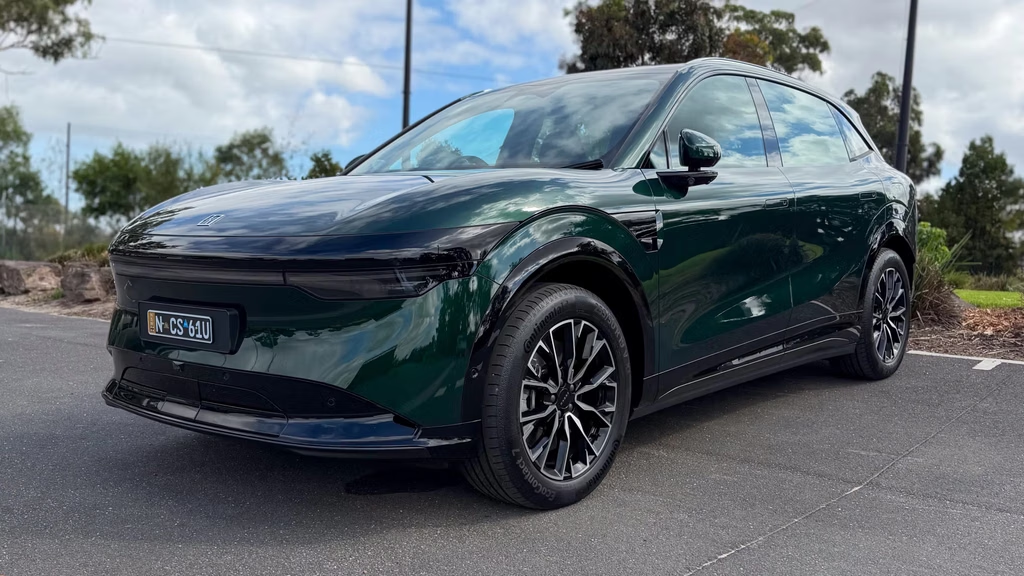

The Dongfeng Citroën C5 Aircross’ position in the Chinese market is essentially a story about mismatch. In Europe, it is a family-positioned SUV with comfort as its core selling point. In China, it faces a compact SUV segment that has been completely reshaped by domestic brands’ new-energy vehicles.
A facelifted version is set to launch on September 23, 2026, following the initial 2026 model year update that arrived earlier this year. This latest iteration brings new exterior and interior color options, along with a standard digital key. The core question remains: what is the C5 Aircross using to persuade buyers in a market that has moved on?
Design & First Impressions


As a model-year facelift, the new C5 Aircross continues the current car’s main design, retaining the ‘sculpted surface expansion’ aesthetic language. Dimensions remain 4510x1860x1705mm, with a 2,730mm wheelbase. This size is mid-to-compact within the compact SUV class.
From a design standpoint, the C5 Aircross has a certain French fullness to its shape; the bulging wheel arches and rounded rear lines make it look more substantial than its actual dimensions suggest. The trade-off is a bootspace of 516-1,310L, which is modest for the class.


The interior includes a 12.3-inch digital instrument cluster plus a 10-inch central touchscreen, supporting both CarLife and HiCar connectivity. In 2026’s Chinese market, this screen size is at an “adequate but not impressive” level as domestic brands at the same price generally offer 15-inch-plus screens as standard.
Powertrain & Performance
The C5 Aircross offers two pure-petrol powertrains in China: the 1.6T and 1.8T with maximum power of 129kW and 155kW respectively, all with 8AT transmission. It is an all front-wheel drive, with a minimum WLTC combined fuel consumption of 6.96-6.97L/100km.
The most noteworthy part of the C5 Aircross is its chassis and suspension. All the models feature “SUV-MCS master-level chassis tuning” paired with PHC adaptive hydraulic stabilisation technology.
The PHC principle uses progressive hydraulic bump stops to provide softer absorption over small bumps and quickly dissipate energy over large impacts, balancing comfort and body control. This system has consistently received positive reviews in the European market.
Spec Sheet
| Specification | Details |
| On sale | September 23, 2026 (facelift) |
| Price (from) | ¥149,700-164,700 (manufacturer guide price for 2026 models) |
| Powertrain | 1.6T / 1.8T turbocharged petrol |
| Max power | 129kW (175hp) / 155kW (211hp) |
| Transmission | 8-speed automatic |
| Drive type | Front-wheel drive |
| Suspension | MacPherson front / multi-link rear, with PHC adaptive hydraulic stabilisation |
| WLTC fuel consumption | From 6.96 L/100km |
| Dimensions (LxWxH) | 4510 x 1860 x 1705 mm |
| Wheelbase | 2730 mm |
| Boot space | 516-1310 L |
| Rivals | Honda CR-V, Toyota RAV4, BYD Song PLUS |
Technology & Infotainment
The C-CONNECT 3.0 system supports OTA updates, voice control, an app store, and remote smartphone control. The dual CarLife and HiCar connectivity covers Android users, but the absence of wireless CarPlay is a drawback for iPhone users.


The flagship trim comes standard with AR real-scene navigation, overlaying navigation information onto the actual road view. This is a feature already widespread among domestic brands but is still rare among joint-venture brands at this price point. This new facelift will also come standard with a digital key.
The new model makes 360o surround view and transparent chassis standard, with the flagship trim offering L2-level ADAs including full-speed adaptive cruise, autonomous emergency braking, and lane keeping.
Value & The Competition
The new C5 Aircross’ core selling points remain chassis comfort and relatively affordable pricing. The current manufacturer price range is on the low side among joint-venture compact SUVs. However, if what you value is chassis quality and French design character, there genuinely aren’t many alternatives at this price.
Against the Honda CR-V, the C5 Aircross’ only wins are chassis comfort and price. The CR-V leads comprehensively in space utilisation, resale value, and brand recognition. Also, the CR-V also offers a hybrid version with a clear fuel economy advantage.
The BYD Song PLUS DM-i presents an unequal contest in China. It offers a plug-in hybrid system at a similar price, can run on electricity for commuting, and has far lower running costs than the C5 Aircross.
Song PLUS DM-i’s infotainment screen size, responsiveness, and feature richness also lead comprehensively. The C5 Aircross’ only advantages carry very low weight in most Chinese consumers’ purchase decisions.
In China’s 2026 compact SUV market, the C5 Aircross is a niche choice. It is not a bad car, but it is a product built for European market logic that appears out of place in the Chinese market context.
Editor’s Take
The real problem facing the new C5 Aircross is not product capability itself, but temporal dislocation.
When Chinese brands at the ¥150,000 price point are using plug-in hybrid systems to reduce fuel consumption, using 15-inch rotating screens to make smart cockpits standard, and using wheelbases above 2800mm to bring rear space up to B-segment levels, the C5 Aircross is still responding with a 1.6T pure petrol engine and a 10-inch screen.
For Dongfeng Citroën, the C5 Aircross’ significance may no longer lie in sales volume itself. It is more like a proof of existence in the Chinese market, to remind customers who still remember Citroën’s chassis that the brand is still here.
Sources: Autohome

Dollars loves following the latest innovations in automobile technology and sharing insights.
When she’s not writing, you can find her playing badminton or diving into a new opera piece.