
On June 15, Geely’s Galaxy TT appeared quietly in China’s thirty-first batch of purchase tax exemption filings, and buried in the government paperwork was a number that deserves more attention than it has received: 725 km of pure electric range in a rear-drive sedan that weighs 1,790 kg and stretches to just under five metres in length, with no dual-motor AWD to pad the efficiency story and no compact, lightweight body to cheat the physics. Just a large, heavy car that Geely is claiming can cover more ground on a single charge than almost anything in its segment.
Rather than chasing the fastest zero-to-hundred time or building the most aggressive tech ecosystem pitch, the brand appears to be going after the thing that neither Xiaomi nor Tesla has fully owned in the large sedan space: genuine long-distance capability that does not ask buyers to sacrifice interior room to get there. Whether the rest of the Galaxy TT lives up to that framing is the question this filing cannot yet answer, but as opening statements go, 725 km in a nearly 1,800 kg sedan is not a quiet one.
Design and First Impressions
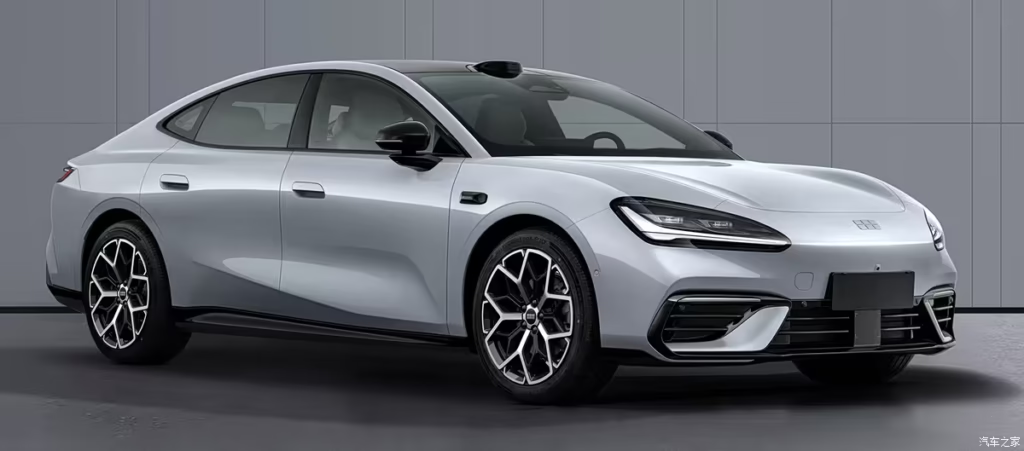
Based on regulatory filing images, the Galaxy TT breaks from the softer lines of the current Galaxy E8. The front end uses a fully closed grille panel flanked by slim, rounded headlight clusters with a three-section lower intake beneath. Raised character lines run along the hood, adding visual tension to what might otherwise read as just another fastback. The profile is defined by semi-hidden door handles, dual five-spoke alloys, and a sloping roofline that cuts toward the rear in a way that reads as deliberately sporty without going full coupe.
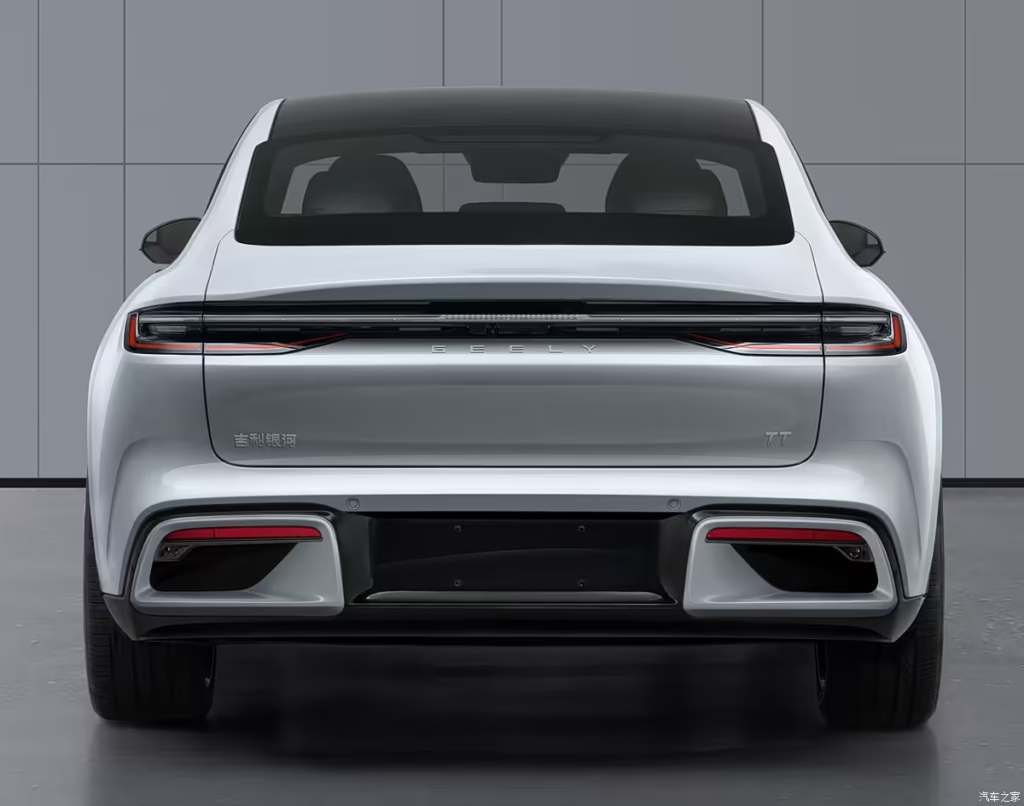
At the rear, a full-width light bar connects both sides of the car, with sculpted light elements at each corner and a large rear bumper. Although the interior details have not been released, the overall package reads younger and sharper than the E8, which suits a car that will likely sit at or near the top of the Galaxy pricing structure.
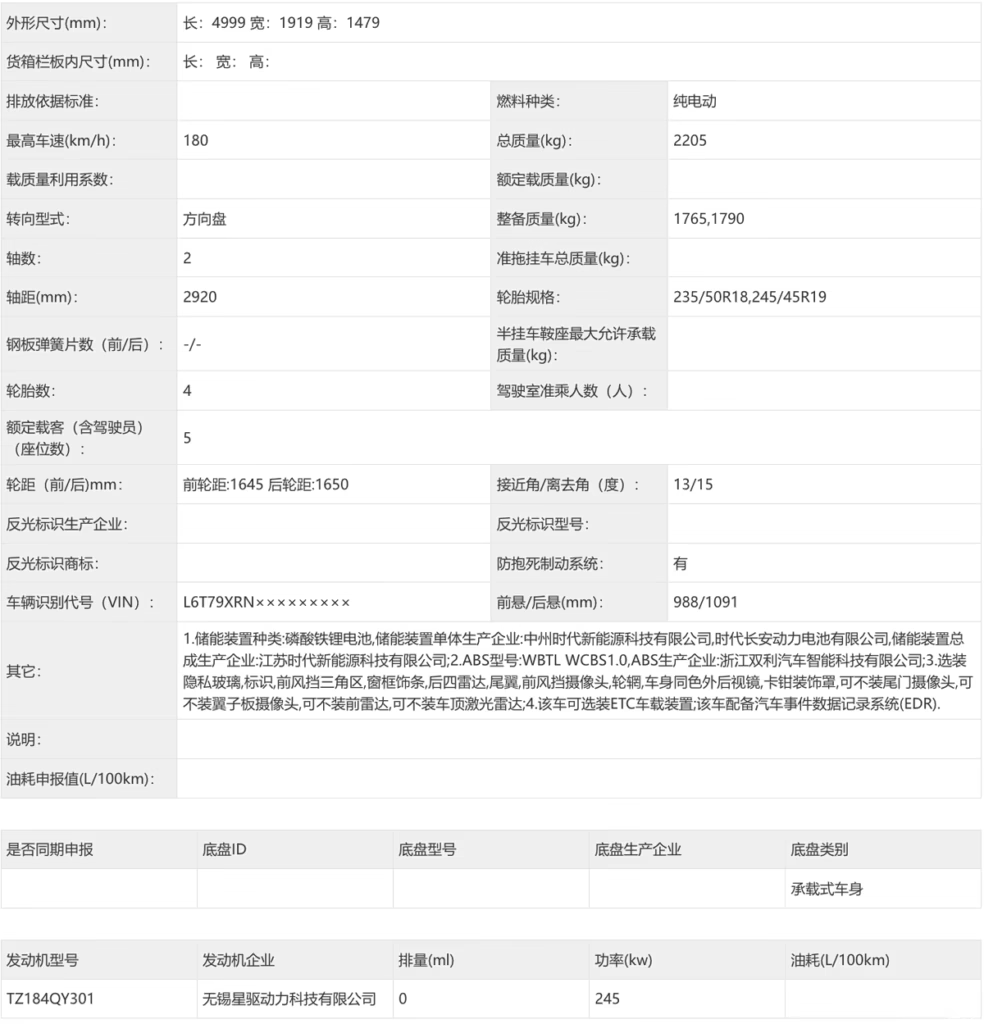
At 4,999 mm long and 1,919 mm wide with a 1,479 mm height, the TT is a large car by any standard. The 2,920 mm wheelbase is within five millimetres of the outgoing Galaxy E8’s 2,925 mm, which means rear legroom should be generous.
Powertrain and Performance
The regulatory catalogue lists three battery pack options: 52.4 kWh, 63.8 kWh, and 75.2 kWh. These correspond to CLTC ranges of 392 km and 465 km on the two smaller packs, with the 75.2 kWh unit offering either 540 km or 537 km depending on variant weight. The higher figures of 640 km, 650 km, and 725 km listed in the tax exemption catalogue for higher-specification trims suggest Geely may use different battery configurations across its variant structure than the three base packs alone imply.
Drive comes from a single rear-mounted electric motor, the TZ184QY301 unit from Wuxi Xingqu Power Technology, producing a maximum of 245 kW, equivalent to 328 hp. No torque figure has been released, and 0 to 100 km/h times have not been published. A 245 kW rear-drive setup on a kerb weight between 1,765 kg and 1,790 kg should be brisk, but without official acceleration data any number here would be speculation.
Charging specifications, battery chemistry, and AC or DC charging speeds have not been disclosed. These will be among the most important numbers to watch at launch, since range credibility in 2026 depends as much on how quickly you can replenish the battery as on how far it takes you.
Galaxy TT Spec Sheet
| On sale | TBA (2026, China) |
| Powertrain | Pure EV, single rear motor, 245 kW (328 hp) |
| Battery capacity | 52.4 kWh / 63.8 kWh / 75.2 kWh |
| CLTC range | 392 km / 465 km / 537-540 km (up to 725 km, higher trims) |
| 0 to 100 km/h | Not yet disclosed |
| Charging (AC/DC) | Not yet disclosed |
| Boot space | Not yet disclosed |
| Kerb weight | 1,765 kg / 1,790 kg (configuration dependent) |
| Gross weight | 2,205 kg |
| Dimensions (LxWxH) | 4,999 x 1,919 x 1,479 mm |
| Wheelbase | 2,920 mm |
| Rivals | Xiaomi SU7, Tesla Model 3, BYD Han L |
Value and the Competition
The Galaxy TT’s most direct rivals are the Xiaomi SU7, the Tesla Model 3, and the BYD Han L, a segment that has become one of the most fiercely contested in China’s EV market.
The Xiaomi SU7 sold 258,164 units in 2025, becoming the first car to unseat the Tesla Model 3 from its dominant position in China’s premium electric sedan market. For 2026, Xiaomi updated the SU7 with more range, faster charging, and a higher-voltage platform, raising prices by around $2,000 across trims. The updated SU7 now claims up to 902 km on CLTC, which makes the Galaxy TT’s top-line 725 km figure less dramatic in isolation. Where the TT could win on the SU7 is physical size: at 4,999 mm, it is meaningfully larger, and the 2,920 mm wheelbase will likely translate into rear-seat space that the SU7 cannot match.
Against the Tesla Model 3, the TT’s large-sedan positioning is a straightforward advantage. The Model 3 Long Range claims 713 km CLTC, but real-world mixed-driving figures for both it and Chinese competitors typically land in the 550 to 600 km range. Tesla retains advantages in software maturity and charging network reliability, particularly outside China, and the Model 3 is a more established product in global markets the TT has not yet reached.
The BYD Han sold 228,000 units in 2024 but saw sales nearly halve to 137,000 in 2025 as the Xiaomi SU7 and Tesla Model 3 ate into its position. A refreshed Han L is now on sale, but the Han name carries lingering perception baggage from that decline. If Geely prices the TT competitively and the interior justifies the spend, Han conquest sales are a realistic target.
Editor’s Take
A 725 km CLTC figure on a near-five-metre rear-drive sedan is genuinely interesting, and not something you can wave away as marketing inflation. CLTC is optimistic, but the efficiency required to hit that number on a 75.2 kWh battery in a car this size means Geely has done real engineering work somewhere, whether in aerodynamics, thermal management, or both. That deserves credit before anything else.
The harder question is whether range is the right hill to plant a flag on in 2026. Xiaomi refreshed the SU7 with a 902 km CLTC claim and had 100,000 pre-orders in fifteen days. The number war in China is accelerating faster than buyers can meaningfully evaluate the differences. At some point, 725 km and 902 km are both just more than enough, and the conversation shifts to software, after-sales confidence, and brand feel. Those are areas where Galaxy, as a sub-brand barely two years into its identity, does not yet have the track record that Xiaomi’s tech ecosystem story or Tesla’s decade of data gives their buyers.
What Geely needs the TT to do is not just hit the range figure. It needs to be the car that makes someone who was going to buy a Han L or a Model 3 feel like they made the aspirational choice. The global naming poll is a smart move, generating conversation before a single spec sheet is confirmed, but conversation is easy. The sedan segment in China right now is where reputations are made and lost in a single product cycle. Geely has stated its intentions clearly. Now it has to build the car.
Sources
Autohome, Batch 31 of the MIIT Announcement

Dollars loves following the latest innovations in automobile technology and sharing insights.
When she’s not writing, you can find her playing badminton or diving into a new opera piece.