
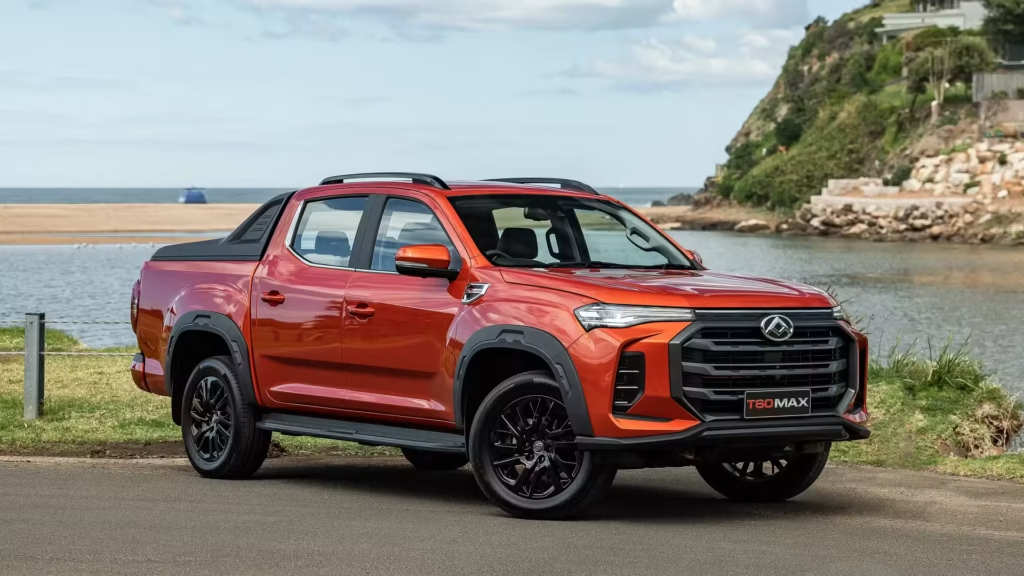
Australia charges zero import tariff on Chinese cars. Unlike Europe (17–35% additional duty) or the United States (100%+), Australian buyers access Chinese vehicles at prices close to export pricing. This is why brands like LDV became the fifth most popular brand in Australia in 2025, and BYD grew 145% year-on-year.
The market is also right-hand drive and has an outsized appetite for utes and SUVs, which shaped which models Chinese brands prioritise here. The BYD Shark 6 PHEV ute, not the Atto 3 or Seal, is BYD’s best-selling vehicle in Australia. That tells you almost everything you need to know about the Australian market’s priorities.
The Brands: What You Need to Know
MG is the longest-established name

MG relaunched in Australia in 2019 under SAIC ownership and is now one of the country’s most familiar Chinese brands, with a dealer network spanning every state. Its strength is value; the MG4 EV consistently undercuts European equivalents, and the ZS EV has become a default recommendation for buyers entering EVs on a budget. The MG3 Hybrid gives the brand an ICE-friendly entry point for buyers not ready to go electric.
GWM has an extensive lineup

Great Wall Motor entered Australia in 2009 with budget utes and is now a top-10 brand with a lineup spanning Haval family SUVs, Cannon dual-cab utes, ORA city EVs and Tank premium off-roaders. The Cannon Alpha PHEV directly rivals the BYD Shark 6 and Ford Ranger PHEV. The Tank 500 PHEV positions GWM against LandCruiser territory at a significant discount. No other Chinese brand covers as many segments in Australia.
LDV: the fleet giant most people overlook
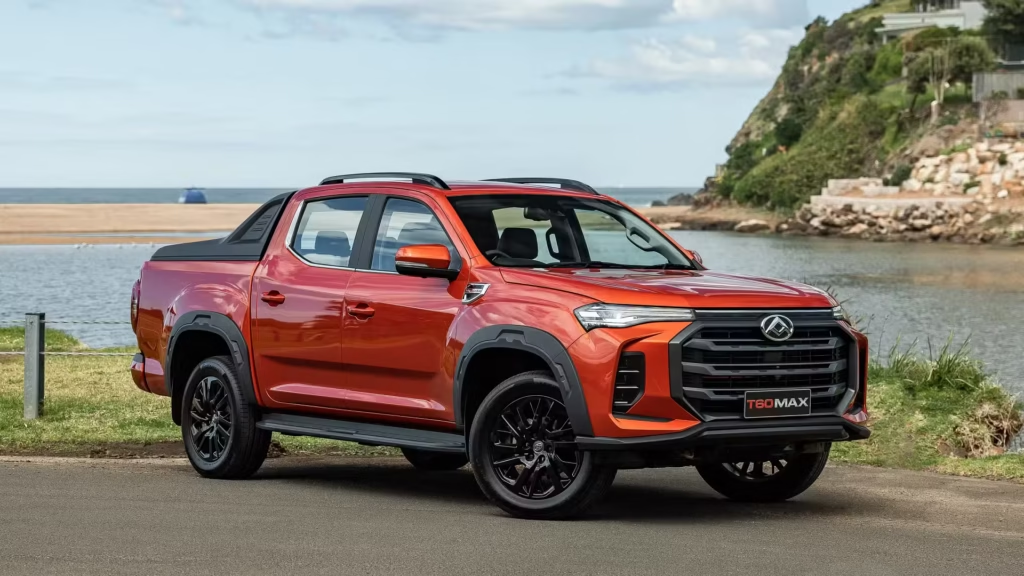
LDV, SAIC’s commercial vehicle arm, was Australia’s fifth most popular brand in 2025, a result most people outside the industry find surprising. Its success is built on electric and diesel vans (the eDeliver range supplies DPD, Toll and major logistics operators), the T60 Max ute, and the D90 seven-seat SUV. Its MIFA 9 luxury electric MPV is a left-field choice for large families. Most buyers encounter LDV through fleet or business purchase decisions rather than personal ones.
BYD is growing fast

BYD arrived in Australia in 2022 and grew 145% in 2025, reaching 8th place overall. The twist is what’s driving that growth: not the Atto 3 or Dolphin, but the Shark 6 PHEV ute, which outsells every other BYD model domestically. Australia’s ute-centric market rewarded the first credible Chinese entry into that segment immediately. The Denza B8 sub-brand targets the LandCruiser and Patrol segment below $100,000 driveaway, an aggressive move into a market Toyota has owned for decades.
Chery group has the most brands

Chery operates more sub-brands in Australia than any other Chinese group: Chery (value SUVs), Omoda (premium-styled crossovers), Jaecoo (rugged SUVs), and soon Lepas (sporty, youth-focused). The Tiggo series gives it an established ICE and PHEV lineup. The Omoda E5 and Jaecoo J5 EV bring the group into the pure-EV segment. The risk, which Chery Australia’s own management acknowledged, is horizontal brand proliferation causing buyer confusion.
Zeekr, Deepal, Xpeng and IM Motors provide the premium push

Four brands are targeting the upper end of the Australian market simultaneously. Zeekr (Geely’s performance EV brand) offers the X and 7X SUVs and 009 MPV with 800V charging. Deepal (Changan) positions the S07 directly against the Tesla Model Y at lower price. Xpeng sells only the G6 currently but plans G9 and X9 expansion.
IM Motors (SAIC/Alibaba joint venture) brings the L6 saloon and LS6 SUV, cars that compete with Genesis and Lexus on specification at a fraction of the price. All four are building dealer networks rather than using established distributors, which means service coverage outside major cities remains thin.
Leapmotor: backed by Stellantis

As in Europe, Leapmotor’s structural advantage in Australia is Stellantis backing. It enters with distribution infrastructure rather than building from scratch. The C10 mid-size SUV and B10 compact EV are its opening moves. A B05 hatchback is confirmed for mid-2026. Pricing is aggressively low, and a PHEV variant of the C10 adds a range-extender option for buyers with limited charging access.
Confirmed for 2026 and Beyond
Australia’s Chinese brand roster is expanding faster than any other market. Confirmed or strongly indicated arrivals:
Nio / Firefly: Nio’s premium brand and its more affordable Firefly sub-brand are in active distributor discussions for Australia.
Jetour (Chery): SUV-focused brand with right-hand drive production confirmed; pre-launch media events in June 2026.
Lepas (Chery): Youth-oriented sporty brand; L4 and L6 SUVs expected late 2026.
GWM Wey: GWM’s luxury PHEV sub-brand, rivalling Denza and Zeekr.
iCaur (Chery): Electric off-road lifestyle brand; V23 EV and V27 PHEV expected.
JAC Hunter PHEV — PHEV variant of the T9 ute, revealed at 2025 Melbourne Motor Show; early 2026 launch.
Editor’s Take
The number of Chinese brands in Australia has already exceeded the number of Japanese brands. That sentence would have been unthinkable five years ago. The zero-tariff environment means Australian buyers get Chinese vehicles at close to their actual cost, which is why the price gaps here are more extreme than in Europe. A Denza B8 large SUV targets the LandCruiser 300 Series at a sub-$100,000 driveaway price. Toyota’s equivalent starts at $97,000 and has a waiting list.
The brands most likely to build durable market presence are the ones that have already committed to national dealer networks and service infrastructure: MG, GWM, LDV, BYD and Chery. The newer premium entrants; Zeekr, Deepal, IM Motors, Xpeng, are building slowly and have thin coverage outside Sydney, Melbourne and Brisbane. For buyers in regional areas, this matters: check whether a service centre is within practical distance before committing to any brand that launched after 2023.
Sources: CarsGuide, RAQ

Hillary started his automotive writing journey at HotCars, and has written for CarNewsChina, GlobalSUV, and many other top auto blogs.
He loves to read, play chess, and supports Liverpool during the weekends


