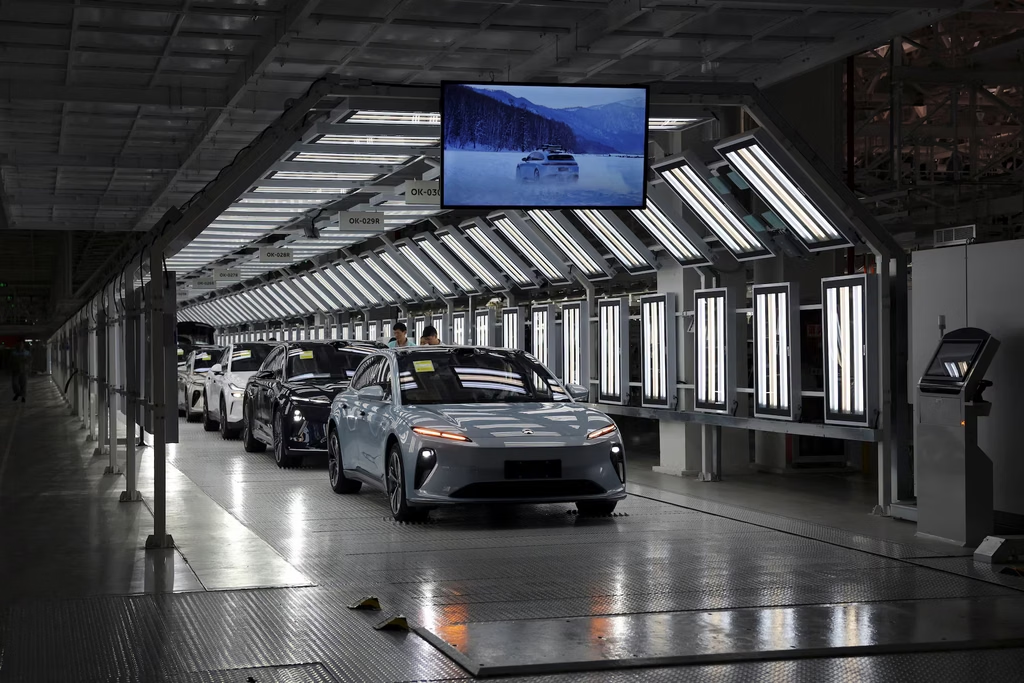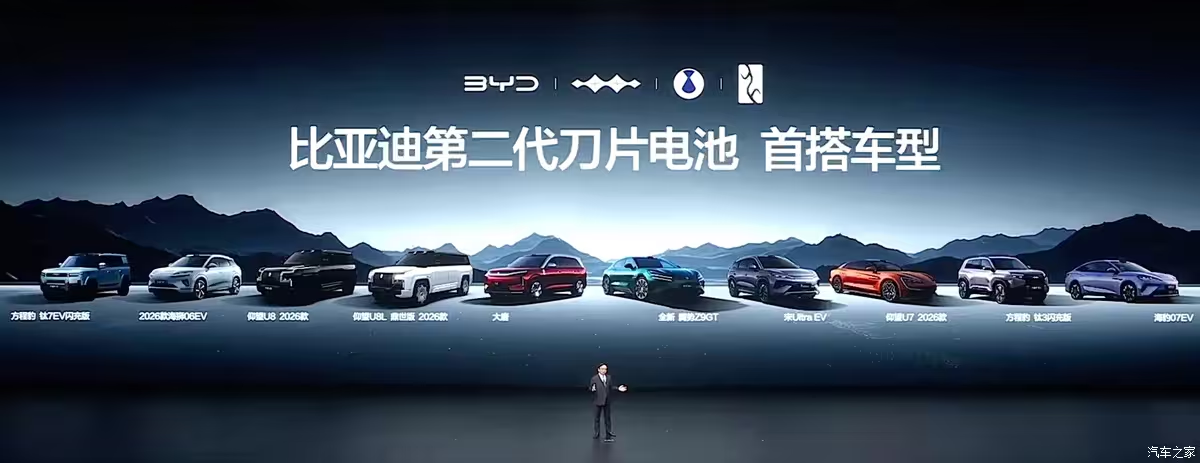

In March 2026, BYD announced that its new Blade Battery 2.0 can charge from 10 to 70 percent in five minutes. A year earlier, CATL’s second-generation Shenxing battery claimed 520 km of range recovered from five minutes of charging, making it the world’s first LFP battery with both an 800 km range and 12C peak charging capability.
Meanwhile, the best-performing Western EV in independent charging tests, the Porsche Taycan and Hyundai Ioniq 6, achieve a 10-to-80 percent charge in around 18 minutes at 270–320 kW. That is an impressive figure by any standard. It is also roughly twice as long as what the leading Chinese cars now achieve.
The gap is real, it is widening, and it is not primarily the result of cleverness. It is the result of structural advantages that China has built over two decades in battery chemistry, supply chain integration, infrastructure investment, and the specific kind of competitive pressure that only an extremely large, extremely demanding domestic market can generate. Understanding why Chinese EVs charge faster requires understanding each layer.
First, a Number That Explains Everything: the C-Rate

Charging speed in EVs is measured by the C-rate. A figure that expresses how quickly a battery can be charged or discharged relative to its total capacity. A 1C rate charges a battery fully in one hour. A 2C rate charges it in 30 minutes. A 5C rate charges it in 12 minutes. A 10C rate, theoretically, in 6 minutes.
Most Western EVs on the market charge at peak rates between 2C and 3C. The Porsche Taycan peaks at around 2.7C on its 93 kWh battery at 270 kW. The Tesla Model 3 peaks at roughly 2.4C. The Hyundai Ioniq 6 reaches approximately 3.3C on its 77 kWh pack at 260 kW, among the best in the Western market.
Chinese EVs have moved to a different tier. The Zeekr 007’s second-generation Golden Battery supports 5.5C charging. CATL’s Shenxing battery for the Zeekr 001 supports 5C. The BYD Blade Battery 2.0 achieves what the company describes as a 10C rate on its flash charging platform. These are not marginal improvements over Western competitors. They represent a categorical shift, and it happened because of decisions made at the battery cell level, not the vehicle level.
Charging speed comparison: Chinese vs Western EVs (2025/26)
| Model | Peak charge (kW) | Peak C-rate | 10–80% time | Architecture |
| BYD Super e-Platform | 1,000 kW | ~10C (peak) | ~5 min (10–70%) | 1,000V |
| CATL Shenxing Gen 2 | 1,300 kW (peak) | 12C (peak) | ~10 min est. | 800V+ |
| Zeekr 007 (Golden Battery) | ~500 kW | 5.5C | 10.5 min | 800V |
| Nio ET7 / ET5 (100 kWh) | ~300 kW | ~3C | ~20 min | 800V |
| Porsche Taycan (93 kWh) | 270 kW | ~2.7C | 22.5 min | 800V |
| Hyundai Ioniq 6 (77 kWh) | 260 kW | ~3.3C | 18 min | 800V |
| Tesla Model 3 LR (82 kWh) | 250 kW | ~2.4C | ~25 min | 400V |
| BMW iX3 (Neue Klasse) | 400 kW | ~3.5C | 21 min | 800V |
C-rates are approximate, calculated from published peak kW and usable battery capacity. BYD Super e-Platform and CATL Shenxing Gen 2 figures are manufacturer claims requiring independent verification. Sources: InsideEVs, S&P Global, TechCrunch, manufacturer specifications.
Battery Chemistry: LFP’s Unexpected Advantage

The dominant battery chemistry in premium Western EVs is NMC (nickel manganese cobalt). NMC offers high energy density, which is why it has become the chemistry of choice for long-range EVs.
Its weakness is thermal sensitivity: NMC cells generate significant heat when charged rapidly, and that heat must be managed carefully to prevent degradation and, in extreme cases, thermal runaway. The thermal management requirement is a hard ceiling on C-rates. Most NMC batteries in production vehicles are limited to 2–3C to preserve cell life and safety margins.
LFP — lithium iron phosphate — was long considered the inferior chemistry. Lower energy density, heavier packs, shorter range per kilogram. BYD and CATL adopted LFP early, partly because it avoids cobalt entirely (which matters for both cost and supply chain stability) and partly because China had deep existing expertise in LFP manufacturing from its years as the world’s largest producer of batteries for consumer electronics and power tools.
The breakthrough came when Chinese battery engineers focused on LFP’s thermal properties. LFP cells are intrinsically more thermally stable than NMC; they are physically less prone to exothermic reactions under high charge rates. BYD’s Blade Battery architecture, which configures cells in long, flat blade shapes that stack directly into the pack without conventional module housings, dramatically improves heat dissipation across the cell surface area.
This is why BYD can claim that its Blade Battery 2.0 achieves a 10C peak rate: the cell geometry and chemistry together allow the thermal load to be managed at C-rates that would destroy a conventional NMC pack. CATL’s cell-to-pack (CTP) architecture on the Qilin and Shenxing batteries achieves the same outcome through a different structural approach, embedding cooling channels directly between the cells, creating what CATL describes as a ‘heat-conducting sandwich’ that maintains cell temperature even at 12C peak charge rates.
Supply Chain: The Advantage No One Can Buy Quickly

China controls approximately 69% of global EV battery production, but that headline figure understates the depth of the advantage. The supply chain for a fast-charging battery is not just the cell; it is the anode material (graphite), the cathode material (lithium iron phosphate or NMC precursors), the electrolyte, the separator, the thermal management components, the silicon carbide (SiC) power electronics that control charge current, and the battery management software that orchestrates all of them. China processes approximately 65–80% of the world’s lithium, 70% of its cobalt, and near-100% of its graphite for battery-grade anode production.
What this means in practice is that when a Chinese battery engineer wants to test a new anode formulation that might improve charge acceptance at high C-rates, they can source candidate materials from a domestic supplier, pilot the formulation in a gigafactory, test it in vehicles, iterate, and return to production faster than a Western competitor can complete the first stage of materials procurement. The iteration cycle is compressed. The feedback loop between cell-chemistry innovation and production-scale validation runs more quickly.
BYD’s advantage is the most extreme version of this. BYD is vertically integrated from lithium mining to finished vehicles. It manufactures its own cells, battery packs, SiC chips (introduced on the Super e-Platform in March 2026), motors, and power management systems.
Competition: Charging Speed is Essential for Survival

The Chinese domestic EV market is the most competitive automotive market in the world. Over 130 electric vehicle models were available in China in 2024. The largest market, mid-size family sedans and SUVs priced between 150,000 and 300,000 yuan, has more than thirty credible competitors. In this environment, charging speed is not a premium feature. It is a basic expectation, and brands that fall behind on it lose sales.
This dynamic does not exist in the same form in Western markets. A European buyer choosing between a Volkswagen ID.7, a Tesla Model 3 and a BMW i4 is comparing cars from established brands with trusted service networks, known resale values, and comparable charging speeds in the 200–270 kW range. The pressure to differentiate on charging speed specifically is moderate. In China, a buyer comparing the Zeekr 007 (5.5C, 10.5 minutes), the Xpeng G6 (vision ADAS, 800V) and the BYD Seal (Blade battery, flash charging) faces products where charging speed is a primary competitive dimension, and every brand knows it.
Li Auto’s commitment to deploy 5,000 charging stations supporting 5C by 2025 was a defensive move to protect its customer base against brands with faster-charging vehicles.
BYD’s plan to expand its Flash Charging network to 20,000 stations by the end of 2026, including 2,000 on highways, is a direct response to competitive pressure from CATL-powered rivals. The investment in fast-charging infrastructure and fast-charging battery technology is mutually reinforcing, and both are driven by a competitive landscape that Western automakers simply do not face in their home markets.
Infrastructure, Real-World Conditions and the Numbers

Every fast-charging claim made by a Chinese manufacturer comes with a condition that is sometimes stated clearly and sometimes not: you need the right charger. Achieving 4C or 5C charging requires at least 360 kW of DC charging power. BYD’s 10C flash charging requires a 1 MW charger. In China’s major cities, ultra-fast charging infrastructure is rapidly expanding. Huawei launched a 1.5 MW charger in 2025, BYD is building megawatt stations, and Zeekr has deployed 1.2 MW chargers at select locations. But in most of China and almost all of Europe, public charging infrastructure lags significantly behind the vehicles’ peak capabilities. A 5C-capable car charging at a 150 kW station, still among the most common fast charger types globally, will charge at roughly 1.5C.
Temperature also matters more at high C-rates. BYD’s Blade Battery 2.0 claims 20% to 97% in under 12 minutes, even at minus 20 degrees Celsius, a specific and notable claim, since cold batteries typically accept charge more slowly.
Independent verification of these cold-weather figures will be important: battery chemistry at minus 20°C behaves differently from that under laboratory conditions, and Chinese manufacturers’ claims have historically been made under optimal test conditions rather than in worst-case real-world scenarios.
The C-rate arms race also raises a legitimate question about what buyers actually need. A Porsche Taycan’s 22.5-minute 10-to-80 percent charge is fast enough that, at a motorway rest stop, the driver has time for a coffee and a bathroom break before the charge is complete. Whether five minutes versus twenty-two minutes represents a meaningful improvement in daily use depends almost entirely on access to charging infrastructure and driving patterns, not on the spec sheet.
What This Means for the Next Five Years

The charging speed gap between Chinese and Western EVs is not going to close quickly. The battery chemistry advantage requires years of investment in LFP engineering to replicate, and most Western automakers remain committed to NMC as their primary chemistry for premium vehicles. The supply chain advantage requires decades to meaningfully challenge: the US and Europe would need to invest an estimated $87 billion and $102 billion, respectively, to build fully local supply chains by 2030. The competitive pressure advantage is structural, as no policy can create the same intensity of domestic competition that China’s market generates naturally.
Western manufacturers are not standing still. The BMW iX3 on the new Neue Klasse platform charges at 400 kW, higher peak power than most current Chinese vehicles can achieve. Polestar’s StoreDot XFC partnership targets 10-minute extreme fast charging.
These are real technological responses. But they are responses to where China was eighteen months ago, not where it is going. CATL’s second-generation Shenxing battery achieves a 12C peak, and the company’s 2025 technology roadmap includes compatibility with 1.3 MW chargers. BYD’s Super e-Platform is already in production. The gap is not static.
For buyers in markets where Chinese EVs are available, charging speed is a practical differentiator that should feature in purchase decisions. The important qualification is infrastructure: a car capable of 5C charging that is used primarily at a 150 kW public charger will not deliver 5C charging. But as ultra-fast infrastructure builds out, particularly in China and in European countries that are aggressively expanding their high-power charging networks, the advantage will become increasingly relevant in the real world. It is already in Shanghai, Shenzhen, and Beijing. It will be in Amsterdam and Oslo within three to five years.
Sources: TechCrunch, S&P Global Automotive Insights, InsideEVs, DestinationCharged

Hillary started his automotive writing journey at HotCars, and has written for CarNewsChina, GlobalSUV, and many other top auto blogs.
He loves to read, play chess, and supports Liverpool during the weekends