
Three Chinese electric cars now claim over 1,000 km of range under CLTC testing, a figure that would have seemed implausible five years ago and still strains credibility today.
Before we rank them, one caveat that applies to every figure in this article: CLTC numbers are not WLTP numbers. China’s test cycle emphasises low-speed urban driving, lighter acceleration, and minimal highway simulation. Real-world range, particularly at motorway speeds in cold weather, is typically 20 to 30 percent lower than the CLTC figure. We flag WLTP equivalents where available and real-world data where it exists.
With that established, here are the ten Chinese EVs that go furthest on a charge, ranked by certified CLTC range, with analysis of what each car is, who it is for, and whether the range claim holds up.
Understanding the Range Numbers: CLTC vs WLTP vs Real World
| Standard | Used in | Vs CLTC | Reliability |
| CLTC | China domestic market | Baseline — highest figure | Optimistic — low speed, mild conditions |
| WLTP | Europe, international | ~15–20% lower than CLTC | More balanced — closer to mixed real-world |
| EPA | USA | ~25–30% lower than CLTC | Most conservative — closest to highway reality |
| Real world (highway) | Everywhere | Often 25–35% lower than CLTC | Varies by speed, temp, load, driving style |
Rule of thumb: Take the CLTC figure, subtract 25%, and you have a reasonable estimate of motorway range. A car claiming 1,000 km CLTC will likely deliver 700–750 km in mixed European conditions.
10. Xpeng X9 BEV (2026) — 750 km CLTC
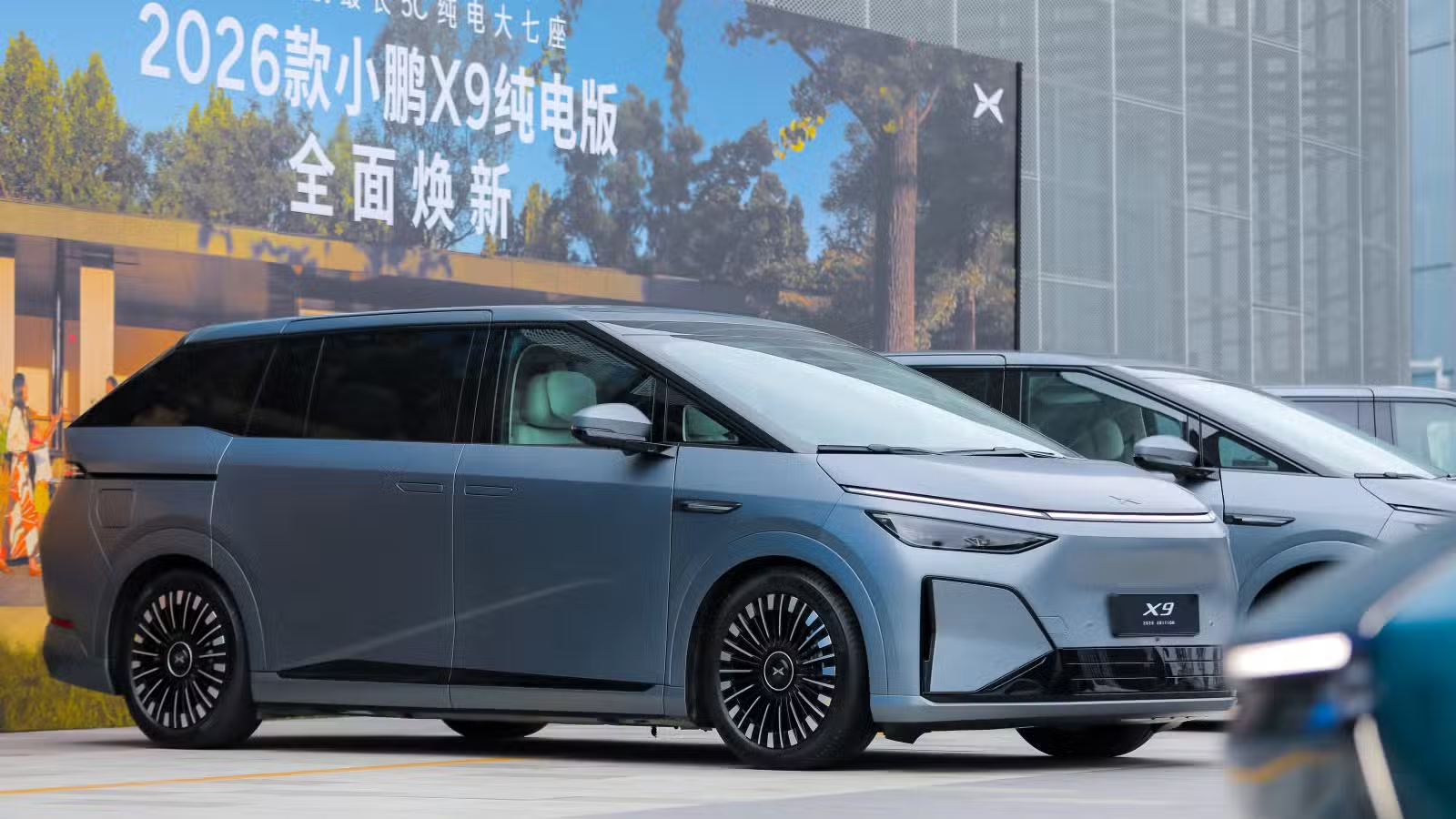
The 2026 Xpeng X9 BEV earns its place on this list not for having the longest range in the segment, but for being the only full-size seven-seat electric MPV to achieve 750 km CLTC, a figure Xpeng claims makes it the world’s longest-range pure-electric seven-seater supporting 5C charging.
For families or businesses requiring a large-format MPV that can cover serious distances, the X9’s 750 km headline with 8-minute 400 km charge recovery (on the 5C 800V platform, available across all variants) addresses the practical concerns that have historically pushed MPV buyers toward EREV powertrains.
9. Zeekr 007 — 870 km CLTC

The Zeekr 007, with a CLTC range of 870 km, makes a compelling case that charging speed can matter more than range. Its second-generation CATL Golden Battery supports 5.5C charging: 10 to 80 percent in 10.5 minutes, with 610 km of range recovered in a 15-minute DC session on the 100 kWh pack.
| Spec | Detail |
|---|---|
| Battery | 100 kWh CATL Golden Battery (NMC) — 5.5C charge rate |
| Platform | 800V |
| Charging (10–80%) | 10.5 minutes at 5.5C — 610 km recovered in 15 min DC |
| 0–100 km/h | 5.0s (RWD) / 3.8s (AWD) |
| Price from | ¥209,900 (~$29,000) — China. European pricing TBC. |
| Real-world range (motorway) | 408.3 km — third place, 2025 Yiche extreme highway test |
| Export availability | Zeekr brand expanding in Europe — 007 export timeline to be confirmed |
The 800V platform gives the 007 a significant practical advantage over the Xiaomi SU7 Pro at public fast chargers. Zeekr is expanding its European presence, and the 007 has been flagged as an export candidate, though right-hand-drive and full European specification had not been confirmed at the time of writing.
8. Xiaomi SU7 Pro (2026) — 902 km CLTC

The Xiaomi SU7 Pro is arguably the most important car on this list for buyers who actually drive long distances. In the August 2025 Yiche extreme highway range test, the most rigorous standardised real-world range assessment conducted in China, covering over 60 models across 20+ brands, the SU7 Pro topped the pure EV category with 457.7 km of real motorway range.
| Spec | Detail |
| Battery | 96.3 kWh CATL Kirin NMC |
| Platform | 400V (note: not 800V — affects DC charging speed) |
| Drag coefficient | 0.195 Cd — joint lowest on this list |
| 0–100 km/h | 5.7 seconds |
| Price from | ¥245,900 (~$34,000) — China only |
| Real-world range (motorway) | 457.7 km — winner of 2025 Yiche extreme highway range test (pure EV category) |
| Export availability | China only as of March 2026 |
The 400V platform is the SU7 Pro’s main limitation on this list. It means DC charging rates are lower than those of the 800V competitors above, and that charge times at public DC infrastructure will be longer per kilowatt-hour added.
7. IM L6 Max Lightyear Edition — 1,002 km CLTC

The IM L6 Max Lightyear Edition is a joint venture product in the most literal sense: IM Motors is owned by SAIC, Pudong New Area government, Alibaba, and the Lightyear semi-solid-state battery was jointly developed by SAIC and Suzhou Qingtao New Energy Technology, with SAIC as Qingtao’s largest shareholder at 15.29 percent.
| Spec | Detail |
| Battery | 123.7 kWh semi-solid-state (Qingtao Energy) — MIIT certified. IM markets as 130 kWh. |
| Platform | Quasi-900V — peak charge rate 400 kW |
| Charging | 400 km range recovered in 12 minutes |
| Powertrain | Dual-motor AWD — 190 kW + 350 kW combined (540 kW) |
| 0–100 km/h | 2.74 seconds |
| Price | ¥345,900 (~$47,600) — China only |
| Export availability | Planned for select Western European markets via MG Motor network (2025). Lightyear Edition availability to be confirmed. |
The L6’s 400 kW peak charge rate on its quasi-900V architecture allows 400 km of CLTC range to be recovered in 12 minutes, one of the fastest absolute charge rates on this list. The 0.195 Cd drag coefficient matches that of the Yangwang U7, and the 2.74-second 0–100 km/h time on the Lightyear Edition’s dual-motor AWD setup makes it the quickest car on this list as well.
6. Yangwang U7 — 1,006 km CLTC

The Yangwang U7 is the most technically extraordinary car on this list. It is simultaneously a 960 kW quad-motor performance machine capable of 2.9-second 0–100 km/h and an ultra-long-range luxury sedan achieving 1,006 km CLTC. a combination of performance and efficiency that should, by conventional engineering logic, be impossible.
| Spec | Detail |
| Battery | 150 kWh BYD Blade Battery 2.0 (LFP) — second-generation cell chemistry |
| Power | Quad-motor — 960 kW (1,287 hp) combined |
| 0–100 km/h | 2.9 seconds |
| Energy consumption | 17.7 kWh/100 km (CLTC) — 10% improvement vs 135.5 kWh predecessor despite +100 kg |
| Drag coefficient | 0.195 Cd |
| Price from | ¥628,000 (~$87,000) — China only |
| Export availability | China only. No Euro NCAP rating. |
The 0.195 Cd drag coefficient matches the Porsche Taycan, one of the most aerodynamically efficient production cars ever made, and does so in a larger, heavier luxury sedan. BYD has not published a full breakdown of how this figure is achieved, but the combination of active underbody panels, flush door handles, and a carefully managed front air intake system is evident in press images.
5. Zeekr 001 Qilin Edition — 1,032 km CLTC

The Zeekr 001 Qilin Edition is a limited production variant, not the standard 001. It was limited to 1,000 units at launch. The MIIT-certified CLTC range of 1,032 km was achieved with an energy consumption of 14.9 kWh/100 km, a remarkable efficiency figure for a car of this size.
| Spec | Detail |
| Battery | 140 kWh CATL Qilin NMC — 200 Wh/kg energy density, 727 kg pack weight |
| Availability | Limited production variant — initially 1,000 units (2023 launch). Check current availability. |
| Price | ¥403,000 (~$55,500) — standard 001 from ¥269,000 |
| Powertrain | Single-motor RWD — 200 kW — 0–100 km/h ~5.9s on this variant |
| Platform | 800V |
| Body style | Shooting brake — 4,970 mm length, 3,005 mm wheelbase |
| Export availability | Zeekr 001 on sale in Europe — Qilin Edition availability varies by market |
The CATL Qilin battery (CTP 3.0) achieves its density through cell-to-pack integration that eliminates conventional module housings, allowing the cells to function simultaneously as structural components. Buyers specifically seeking the 1,032 km Qilin Edition should verify current availability carefully.
4. Denza Z9 GT — 1,036 km CLTC

The Denza Z9 GT is the shooting brake variant of the Z9. Longer, lower, and more dramatic in silhouette at 5,195 mm, with a 3,125 mm wheelbase. It uses the same 122.5 kWh Blade LFP battery as the Z9 sedan and achieves 1,036 km CLTC, slightly less than the sedan’s 1,068 km due to marginally higher aerodynamic drag from the fastback roofline.
| Spec | Detail |
| Battery | 122.5 kWh LFP Blade |
| Body style | Shooting brake — 5,195 mm length, 3,125 mm wheelbase |
| Platform | BYD e-Platform 3.0 — 800V |
| Price from | ¥354,800 (~$49,000) — current generation, China only |
| PHEV variant | 63.82 kWh battery — 400+ km electric range |
| Export availability | China only as of March 2026. No Euro NCAP rating. |
BYD described the Z9 GT as the world’s longest-range production EV at its March 2026 reveal, though the Z9 sedan’s higher figure means that claim requires the qualifier ‘shooting brake’. Dimensionally comparable to a Porsche Panamera Sport Turismo, the Z9 GT is the more visually compelling of the two Z9 variants. A PHEV version with a 63.82 kWh battery delivering over 400 km of electric-only range is also available, nearly double the outgoing PHEV’s 201 km
3. Nio ET7 — 740 km CLTC (standard 100 kWh pack)

The Nio ET7‘s standard 100 kWh semi-solid-state pack delivers 740 km CLTC, strong by any measure, though it ranks below the ET5 because the ET5’s 100 kWh pack is more efficient relative to the car’s weight. Where the ET7 distinguishes itself is in safety: it scored 96 percent for adult occupant protection under the 2023 Euro NCAP protocol, the highest score recorded that year.
| Spec | Detail |
| Standard battery | 100 kWh semi-solid-state — 740 km CLTC |
| 150 kWh upgrade | 1,050 km CLTC — via Power Upgrade subscription, not included in purchase |
| Platform | 800V — 0–100 km/h in 3.8s |
| Price from | ¥428,000 (~$59,000) — China. European pricing higher. |
| Safety | Euro NCAP 5 stars, 2023 protocol — 96% adult occupant protection (highest score in 2023) |
| Export availability | On sale in select European markets |
With the 150 kWh Power Upgrade pack, the ET7 reaches 1,050 km CLTC. Nio claims the ET7 with the 150 kWh pack is the only BEV executive sedan to have completed a verified 1,000+ km challenge under real-world conditions. As with the ET5, this figure is notable but should be considered separately from the standard-pack comparison.
2. Nio ET5 / ET5T — 830 km CLTC (standard 100 kWh pack)

The Nio ET5 is the most relevant car on this list for international buyers. Its 100 kWh semi-solid-state pack delivers 830 km CLTC, and it earned five stars under the 2023 Euro NCAP protocol, scoring 91 percent in adult occupant protection. It is the only car in the top seven of this ranking with a credible Euro NCAP result and genuine export availability. The ET5T is the estate variant with the same powertrain and near-identical range, offering more boot space for families.
| Spec | Detail |
| Standard battery | 100 kWh semi-solid-state — 830 km CLTC (ET5 sedan) / 810 km (ET5T touring) |
| 150 kWh upgrade | 1,055 km CLTC (ET5) / 1,010 km (ET5T) — via Power Upgrade subscription, not included in purchase |
| Platform | 800V — 0–100 km/h in 4.3s |
| Price from | ¥298,000 (~$41,000) — China. European pricing higher. |
| Safety | Euro NCAP 5 stars, 2023 protocol — 91% adult occupant protection |
| Export availability | On sale in Europe (Norway, Netherlands, Germany, Sweden, Denmark) |
Nio’s 150 kWh semi-solid-state battery, available via the Power Upgrade subscription through its swap network, pushes the ET5 to 1,055 km CLTC and the ET5T to 1,010 km. This is genuinely useful for long-distance trips where a swap station is available, but buyers should not count this figure in direct comparison to cars whose headline range is achieved on a standard purchased pack. The 830 km standard figure is the honest comparison point, and it is still exceptional.
1. Denza Z9 — 1,068 km CLTC

The Denza Z9 currently holds the certified production-car range record, with a 122.5 kWh battery and a 1,068 km CLTC range, as recorded in Chinese regulatory filings. Denza is BYD’s premium sub-brand, originally a joint venture with Mercedes-Benz, though the German partner has since reduced its stake. The Z9 is a large, five-metre luxury sedan positioned against cars like the Mercedes EQS.
| Spec | Detail |
| Battery | 122.5 kWh LFP Blade (also: 102.3 kWh / 820 km variant) |
| Platform | BYD e-Platform 3.0 — 800V |
| Price from | ¥354,800 (~$49,000) — China market |
| Energy consumption | ~14.5 kWh/100 km (CLTC est.) |
| Export availability | China only as of March 2026. No Euro NCAP rating. |
| Rivals | Mercedes EQS, Li Auto Mega, Denza Z9 GT |
At a CLTC-to-WLTP conversion of roughly 15–20 percent, that 1,068 km figure translates to approximately 855–910 km WLTP, still class-leading if achieved. A smaller 102.3 kWh battery option delivers 820 km of CLTC range. The Z9 is not yet widely available outside China, and no Euro NCAP results have been published.
Editor’s Take
The 1,000 km club makes for compelling headlines, and the Denza Z9’s 1,068 km certified range is a genuine engineering achievement. But before anyone factors that number into a purchase decision, they should sit with the real-world arithmetic for a moment. At 120 km/h motorway speeds in 5-degree winter temperatures, that 1,068 km CLTC figure becomes something closer to 680–720 km. That is still excellent, class-leading in any reasonable frame of reference, but it is not 1,068 km.
The car I keep coming back to on this list is the Xiaomi SU7 Pro, not because it has the longest range, but because it has the most honest range. Its 457.7 km in the 2025 Yiche extreme highway test represents a CLTC-to-real-world retention rate that few competitors can match. The aerodynamics on the SU7 are doing real work at speed. For buyers who actually drive long distances rather than just park with a full battery, the SU7’s real-world credentials deserve more attention than they typically receive.
The Nio ET7 is the right answer for European buyers on this list, and not purely because of range. It has a legitimate Euro NCAP five-star rating from the 2023 protocol, the most demanding version yet administered, and a genuine dealer and service presence in several European markets. The other cars here are either China-only, lack safety ratings relevant to European buyers, or have such limited export availability that purchasing one outside China poses a real risk. Range matters, but it matters less than being able to get the car serviced after the warranty expires.
Source: All CLTC range figures sourced from Chinese MIIT regulatory filings or official brand specifications as of March 2026. Prices are China domestic market figures in yuan unless stated. The guide will be updated as new models enter production.

Hillary started his automotive writing journey at HotCars, and has written for CarNewsChina, GlobalSUV, and many other top auto blogs.
He loves to read, play chess, and supports Liverpool during the weekends