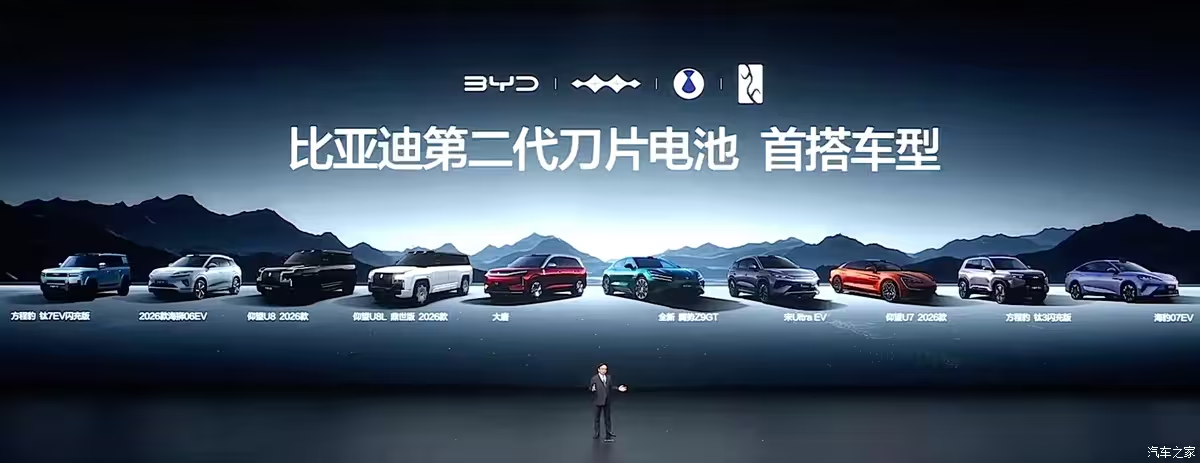
On the evening of March 5th in Shenzhen, BYD held what it called a ‘Disruptive Technology’ event. The centrepiece was the second-generation Blade Battery, a rebuilt-from-the-cell-up LFP platform that achieves 10–70% charging in five minutes at room temperature, 10–97% in nine minutes, and 20–97% in twelve minutes in temperatures as low as 30 °C.
Alongside it, BYD launched a new Megawatt Flash Charging station with a single-gun peak output of 1,500 kW, compatible with any vehicle on a 400V to 1,000V architecture and open to all brands, not just BYD. Eleven vehicles across the Dynasty, Ocean, Denza, Yangwang, and Fang Cheng Bao brands were launched or premiered on the same evening, all equipped with the new battery.

The timing was not coincidental. BYD has been under significant pressure. Combined January and February 2026 sales dropped roughly 36% year-on-year, with February alone falling 41%, the steepest single-month decline since early 2020. The proximate cause is well understood: China’s full purchase tax exemption on new energy vehicles expired at the end of 2025, replaced by a 5% levy from January 1st. The policy shift created an enormous surge in demand in late 2025 as buyers rushed to beat the deadline, followed by an equally large demand vacuum in January and February.
BYD sold 420,398 vehicles in the final months of 2025, a surge that borrowed directly from 2026 sales. CEO Wang Chuanfu’s technology showcase was the company’s answer to that vacuum: new reasons to buy, rather than a price cut.
Wang framed the event as the automotive industry’s remaining barrier to full electrification. BYD’s own research found that range anxiety has effectively been resolved. China now has multiple times as many public fast chargers as petrol stations, but two problems persist: charging is slow relative to refuelling, and it degrades severely in cold weather. The Blade Battery 2.0 is built explicitly to close both gaps.
The Blade Battery 2.0: What Changed

BYD developed the second-generation Blade Battery over six years and was deliberately opaque about cell-level specifications at the event itself. What has been confirmed officially: energy density improves by 5% over the first generation (industry sources have cited a target of around 200 Wh/kg, compared with approximately 190 Wh/kg for the original Blade).
Capacity retention loss is reduced by 2.5% over the battery’s life. The battery is available in two formats: a Long Blade 2.0 targeting maximum energy density for flagships like the Yangwang U7 (150 kWh, 1,000+ km CLTC), and a Short Blade 2.0 optimised for power throughput rather than energy capacity, used in the Seal 07 EV, supporting an 8C charge rate and 16C discharge rate.
The key engineering advance is a redesigned Solid Electrolyte Interphase (SEI) layer, built using molecular-level engineering. BYD describes it as ultra-thin, allowing higher ionic conductivity, and highly dense, ensuring chemical stability. Dynamic self-repairing technology maintains structural integrity across repeated charge cycles. This is paired with a millisecond-level intelligent thermal management system that operates across the full temperature range, addressing LFP’s historically poor cold-weather charge acceptance.
Safety benchmarks cleared include: the world’s first simultaneous Flash Charging and nail penetration test — no thermal runaway, smoke, or fire after 500 flash charge cycles; forced short-circuit across four cells simultaneously at temperatures exceeding 700°C — no fire or explosion; and 1,500-joule underfloor impact — no fire or explosion. The warranty is enhanced: if battery capacity falls below 77.5% within six years or 150,000 km, a free replacement is provided. Cell lifetime warranty is maintained.
The Megawatt Flash Charging Network

BYD’s new Flash Charging stations use an overhead T-shaped suspended rail design, cables hang from above rather than lying on the ground, which addresses longstanding owner complaints about heavy, dirty, and winter-stiff charging cables. Single-gun peak output: 1,500 kW. Total unit capacity: 2,100 kW across two guns. Voltage range: 400V–1,000V. Cable and gun weight: 2 kg.
The stations are open to all brands, and an idle fee will apply to vehicles that overstay their charging time, a petrol-station convention applied to EV infrastructure for the first time at scale.
Wang Chuanfu explained at the event that converting China’s 4.8 million existing chargers to megawatt-level output would require 4,800 GW of grid capacity — more than China’s entire national generation capacity of 3,800 GW. BYD’s solution is a ‘station-within-a-station’ model: Flash Charging piles are embedded inside existing third-party charging sites, with BYD’s 120 kW grid connection feeding into a dedicated energy storage buffer.
That buffer absorbs off-peak grid energy and releases it as megawatt-level DC output on demand, allowing a standard grid connection to deliver 1,500 kW peaks. Wang described the installation process as being roughly as complex as fitting an air conditioner. As of March 5th, BYD had already completed 4,239 Flash Charging stations under this model in the first two months of the year.
Charging Station Rollout — China 2026
| Brand | Stations (March 2026) | 2026 target | Notes |
| BYD Flash Charging | 4,239 | 20,000 | 18,000 urban (station-within-a-station) + 2,000 highway. 1,000 highway stations by May 1. |
| Nio Power | 8,676 | Not stated | Includes 3,750 battery swap stations |
| Li Auto | 4,000+ | Not stated | — |
| Xpeng | 3,200+ | Not stated | — |
| Tesla Supercharger | 2,500+ | Not stated | Open to all brands in China |
BYD also announced a ‘Dream Station’ programme: if four BYD owners in a location request a Flash Charging station and the site is physically suitable, BYD will build one within one week. Buyers of second-generation Blade Battery vehicles receive one year of free Flash Charging.
Global rollout has been confirmed, with details to follow. In Europe, the Denza Z9 GT will be the first vehicle to carry Flash Charging; European specifications are expected in the coming weeks. BYD Australia confirmed it is building charging network infrastructure in preparation for deployment over the next 12 to 18 months, with stations potentially deployed at BYD and Denza dealerships.
All 11 Vehicles
First-wave Blade Battery 2.0 vehicles — CLTC range summary
| Model (English name) | BEV CLTC range | Price (CNY) | Status |
| Denza Z9 GT | 1,036 km | ¥269,800–369,800 | On sale March 5 |
| Yangwang U7 | 1,006 km | ¥658,000+ | On sale March 5 |
| BYD Great Tang (Dynasty SUV) | 950 km | ¥400,000+ (est.) | World premiere — H1 2026 launch |
| Fang Cheng Bao Titanium 7 EV | 755 km | TBC — March 13 event | World premiere — details March 13 |
| BYD Song Ultra EV | 710 km | ¥155,000 (pre-sale) | Pre-sale opened March 5 |
| BYD Sea Lion 06 EV (updated) | 710 km | ¥159,900–179,900 | On sale March 5 |
| BYD Seal 07 EV | 705 km | ¥169,900–189,900 | On sale March 5 |
| Fang Cheng Bao Titanium 3 (flash) | 620 km | TBC — March 13 event | World premiere — details March 13 |
| BYD Seal 08 (reveal) | 1,000 km+ (target) | ~¥300,000–350,000 (est.) | World premiere — Q2 2026 launch |
| Yangwang U8 (updated) | 230 km BEV / 1,205 km combined | ¥1,008,000+ | On sale March 5 |
| Yangwang U8L Pinnacle Edition | 230 km BEV / 1,205 km combined | ¥1,300,000+ | On sale March 5 |
CLTC typically overstates the range by ~35% relative to EPA. Seal 08 1,000 km+ is a target, not a certified rating. Fang Cheng Bao prices TBC.
Key Vehicles in Detail
Denza Z9 GT: from ¥269,800 (~$39,100)

The Z9 GT is the headline car of the event and the first vehicle BYD’s official press release calls out by name. It holds the title of the world’s longest certified CLTC pure-electric range at 1,036 km, a 64% improvement on the outgoing model. That record will almost certainly be beaten within 2026, but it establishes where the range frontier now sits.
The update adds a new single rear-motor variant at 370 kW and a starting price cut of 24%, from ¥355,800 to ¥269,800. The existing tri-motor configuration (230 + 310 + 310 kW, 0–100 km/h in 2.7 seconds) carries over. Three battery options: 102.3 kWh (820 km CLTC), 122.5 kWh (880 km and 1,036 km depending on trim), and a PHEV with a 63.82 kWh battery delivering 401 km electric-only, double the outgoing PHEV’s 201 km.
Exterior updates include a revised front and rear bumper, sharper lines, a LiDAR unit added to the nose and three new colours: Crystal Grey, Fjord Green and Aurora Purple. The Z9 GT is confirmed as the first Denza vehicle to carry Flash Charging to European markets.
BYD Seal 07 EV: from ¥169,900 (~$24,600)

The Seal 07 EV is a mid-size four-door fastback sedan and the vehicle most comparable to the Xiaomi SU7, which it undercuts by 21.3% at entry level. At 4,995 mm long with a 2,900 mm wheelbase, it uses BYD’s Short Blade 2.0 (the power-optimised variant) in a 69 kWh pack for 705 km CLTC. The Short Blade 2.0 supports an 8C charge rate, enabling the car to add roughly 400 km of range in five minutes on a Flash Charger.
It is the first Ocean series vehicle to carry the Tianshenzhi Eye (God’s Eye) 5.0 ADAS system, supporting urban NOA across all trim levels. Interior: three-screen ‘2+1’ configuration with W-HUD, column gear selector, wireless charging and a heating/cooling refrigerator. LiDAR is roof-mounted. Deliveries begin from the Changzhou plant in late March 2026.
BYD Sea Lion 06 EV: from ¥159,900 (~$23,200)

The Sea Lion 06 is the highest-volume car in this launch and carries the most significance for the mainstream market. The body is unchanged at 4,810 x 1,920 x 1,675 mm on a 2,820 mm wheelbase, but the powertrain is upgraded to 240 kW and 270 kW single rear-motor options with CLTC range of 620 km and 710 km respectively.
New standard equipment includes a 15.6-inch floating central screen running DiLink 6.0, W-HUD head-up display, 50W wireless charging, a cooling/heating refrigerator, 12-speaker Dynaudio audio, front-passenger zero-gravity seat, and BYD’s Yunnie-C intelligent body control system now standard across all trims. A new interior colour, Ocean Blue, is introduced.
BYD Song Ultra EV: pre-sale from ¥155,000 (~$22,470)

The Song Ultra EV is the most accessible vehicle in the launch and the most significant for export markets. At 4,850 mm long with a 2,840 mm wheelbase, it is a mid-size five-seat SUV positioned as a direct competitor to a rear-wheel-drive Tesla Model Y at substantially lower price. It includes a front boot (frunk).
Power options are 240 kW and 270 kW single rear motors, with CLTC range of 620 km and 710 km. It runs the Tianshenzhi Eye B ADAS system supporting highway and urban assisted driving, BYD Flash Charging, Yunnie-C, and a tyre blowout stability system (TBC). Pre-sales opened March 5; full launch pricing to follow.
BYD Great Tang (Datang) — ¥400,000+, H1 2026

The Great Tang is BYD’s first large Dynasty-brand SUV above the ¥400,000 threshold, a price tier BYD has not previously occupied in this body style. At 5,263–5,302 mm long with a 3,130 mm wheelbase, it is a seven-seater in 2+2+3 configuration, with zero-gravity second-row seats, a folding screen, side tables and a refrigerator.
BEV variants target 950 km CLTC with a 3.9-second 0–100 km/h time. Equipment includes Flash Charging, Yunnie-A air suspension, dual-chamber air springs and road-preview technology. Expected to launch in the first half of 2026.
BYD Seal 08: World Premiere, Q2 2026

The Seal 08 is BYD’s Ocean flagship fastback, at 5,150 x 1,999 x 1,505 mm on a 3,030 mm wheelbase. It is a large-format luxury performance sedan aimed squarely at the Xiaomi SU7 Ultra and similar products. It targets over 1,000 km CLTC range.
The quad-motor variant is expected to exceed 480 kW combined with a sub-5-second 0–100 km/h time. Rear-wheel steering and Yunnie-A air suspension are confirmed. Q2 2026 launch; estimated ¥300,000–350,000.
Yangwang U7 and U8 / U8L Pinnacle Edition
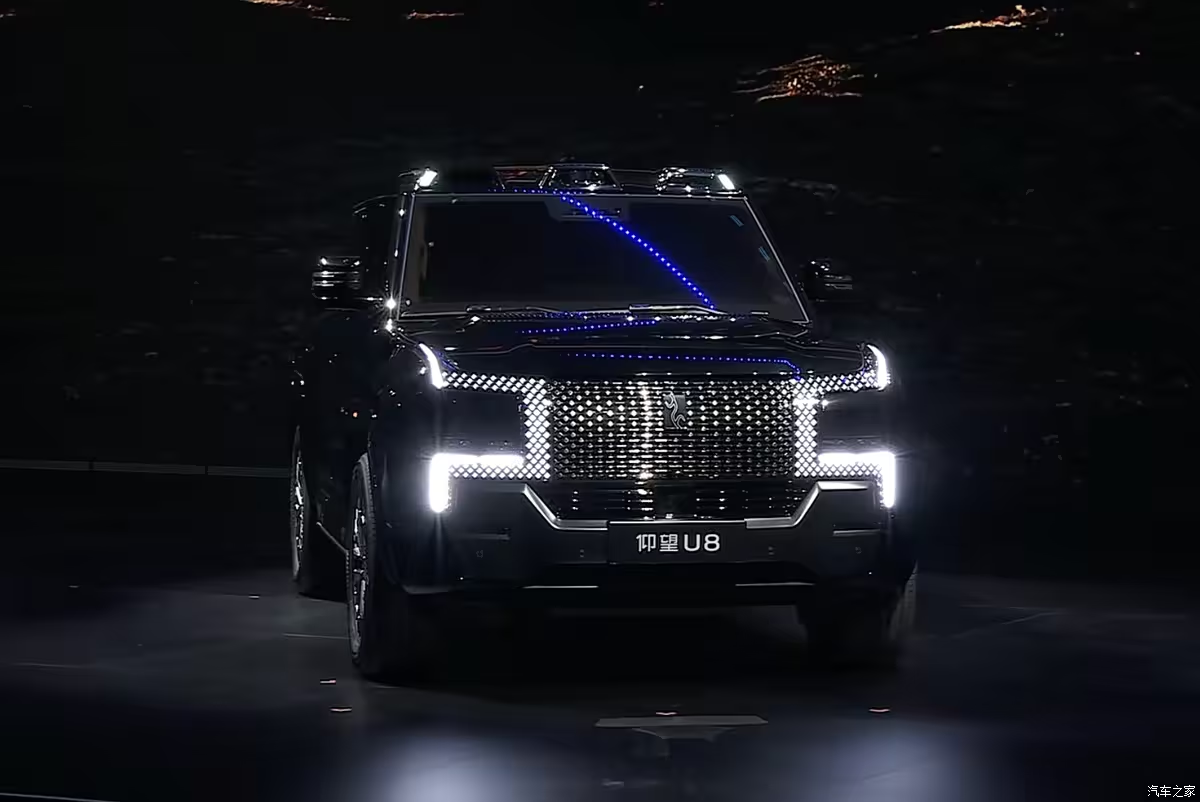
The updated Yangwang U7 receives the 150 kWh Long Blade 2.0 and achieves 1,006 km CLTC, paired with four permanent-magnet synchronous motors producing a combined 960 kW (1,287 hp) and a 0–100 km/h time of 2.9 seconds. Starting at ¥658,000 (~$95,000).
The updated Yangwang U8 starts at ¥1,008,000 (~$146,000), gains Yunnie-P Plus suspension, Easy Four-Way road sensing, pure-electric range of 230 km and combined range of 1,205 km. The U8L Pinnacle Edition at ¥1,300,000 adds emergency floatation auto-activation, NOA blowout stabilisation and full-scenario privacy security functions.
Why BYD Needs Blade 2.0
BYD launched the original Blade Battery in 2020 primarily as a structural safety argument, the nail penetration test that demonstrated LFP cells could survive conditions that cause NMC cells to ignite. The second generation shifts the primary narrative from safety to speed, while maintaining and extending the safety credentials.
The five-minute charge claim, if it holds under independent real-world testing, collapses the last meaningful practical objection to EVs over ICE in markets with adequate infrastructure. Wang Chuanfu cited BYD’s own research: ICE vehicles in China average 500–600 km on a full tank of fuel. The Blade Battery 2.0 vehicles now match or exceed that range, and they refuel in comparable time.
The domestic competitive context is acute. Nio’s combined January-February sales rose 77% year-on-year. Zeekr rose 84%. Xiaomi, which launched the SU7 barely a year ago, sold over 59,000 units in the same period, up 48% year-on-year. BYD’s domestic share, which had ranged between 26–34% in 2024–2025, is under visible pressure as competitors move upmarket and improve their technology offer.
A repeat of last year’s ‘God’s Eye for free’ strategy, which triggered a demand inflection without requiring a price cut, appears to be the model: deploy new technology broadly and quickly, before competitors can respond.
One structural detail deserves attention beyond the vehicle launches: BYD’s exports crossed domestic sales for the first time in February 2026, with overseas shipments reaching 100,600 units, a 50% year-on-year increase, the fourth consecutive month above 100,000. BYD has set an overseas sales target of 1.3 million units for 2026, nearly the entire scale of Chery’s 2025 exports, which spent two decades building to that level.
In Europe, BYD surpassed Tesla in new vehicle registrations in January 2026, with over 18,000 units registered, nearly triple the prior-year figure, as Tesla’s European registrations fell 17%. The Flash Charging network’s confirmed global rollout and the Denza Z9 GT’s European flash-charging debut are the infrastructure and product pieces of that overseas push.
What to Watch

Three claims in BYD’s announcement require verification before they can be treated as settled.
Charging speed under real conditions
The five-minute 10–70% figure requires a 1,500 kW Flash Charger. China has 4,239 of those stations as of March 5th, against a target of 20,000 by year-end. Most BYD owners, and certainly most owners outside China, will not have access to a megawatt charger for some time. The 30–50% faster charging claim on standard piles is more immediately relevant for the majority of users and deserves more attention than the headline figure.
Cold-weather performance
BYD claims 20–97% in twelve minutes at minus 30°C, a specific and ambitious figure for LFP chemistry, which has historically shown poor cold-weather charge acceptance. Independent owner data from cold-climate markets (Scandinavia, northern China, Canada) over the next winter season will be the real test. The claim was made under controlled conditions; real-world cold-weather charging involves variables that laboratory tests do not replicate.
Range vs. real-world driving
All range figures quoted are CLTC, which typically overstates real-world range by approximately 35% compared to the EPA test cycle. A Denza Z9 GT claiming 1,036 km CLTC equates to roughly 675 km under EPA-equivalent conditions, still class-leading, but a materially different number than the headline. International readers should apply this correction to every range figure in this article.
Editor’s Take
The number that should lead every piece of coverage about this event is not 1,036 km, or five minutes, or even 1,500 kW. It is eleven. Eleven production vehicles, all receiving the same new battery platform, all to be delivered within this calendar year, spanning a price range from ¥155,000 to ¥1,300,000. No other manufacturer in the world has done this.
The gap between announcing a new battery and shipping it at scale in eleven simultaneously launched vehicles is exactly the kind of execution that competitors can admire without being able to replicate quickly.
The Flash Charging network decision to open stations to all brands is the detail that will matter most over five years. This is a deliberate strategic choice as Wang Chuanfu knows that a charging network only becomes valuable when it has density, and density requires utilisation, and utilisation requires every EV to be able to use it.
A 20,000-station BYD network open to Nio, Tesla, Xpeng and every other EV in China becomes a piece of national infrastructure. The brand association that creates is worth more than the electricity revenue from competitor vehicles.
The honest caveat is the sales backdrop. BYD is launching this technology in the middle of a six-month domestic sales decline driven by a tax change that was, in a sense, self-inflicted by the spectacular success of the fourth quarter of 2025.
The demand was borrowed from 2026, not destroyed. But the pressure to demonstrate that Blade Battery 2.0 and Flash Charging translate into sales recovery is real. The event was well executed. The technology appears genuine. Whether the network buildout and the sales recovery happen at the pace BYD has implied is the story to follow through the rest of the year.
Sources: TechCrunch, CNBC, Automotive World, Electrek, BYD official press release.

Hillary started his automotive writing journey at HotCars, and has written for CarNewsChina, GlobalSUV, and many other top auto blogs.
He loves to read, play chess, and supports Liverpool during the weekends