
The Chinese EV conversation in Europe suffers from a persistent confusion between cars that are announced and cars that are available to order today. Several models that generate significant press coverage are either not yet on sale, available only in select countries, or sitting in a grey-import category that provides no warranty support. This guide covers only models currently available through official channels in at least 2 major European markets, with confirmed pricing and a functioning dealer network. Every car in this list can be ordered and collected.
The guide is structured by use case rather than price bracket, because the question most buyers actually face is not ‘what can I get for €X?’ but ‘what is the right car for how I drive?’ A buyer who does 200 km daily on motorways needs a different car from someone who commutes 20 km each way through a city. The same budget, very different needs.
The Cars by Use Case
Best for city driving: Leapmotor T03

The T03 starts at around €15,000 in most European markets, making it the most affordable new electric car you can buy from an official dealer across the continent. It is a small five-door hatchback with a WLTP range of 265 km, a 45 kW DC charging ceiling, and a cabin that fits four adults. By the objective measure of euros per kilometre of range, nothing comes close.
The T03’s weaknesses are the ones you would expect at this price: the interior materials are thin, the range is genuinely limited for anything beyond urban use, and the 45 kW charging means a motorway top-up takes time. For its intended purpose, commuting and city errands with home charging, it is very good. The Stellantis distribution network means you can buy and service it at a Peugeot or Citroën dealer, which removes the after-sales uncertainty that surrounds some newer Chinese brands.
Buy if: You live in a city, charge at home, and want the lowest possible monthly cost of EV ownership.
Skip if: You regularly drive more than 150 km in a day or rely on public rapid charging.
Best budget entry with more range: BYD Dolphin Surf

The Dolphin Surf sits just above the T03 in price and meaningfully above it in product. BYD’s Blade Battery safety credentials, 260 km of WLTP range, Vehicle-to-Load capability as standard, and the brand recognition that comes with being the world’s largest EV manufacturer combine at an entry price under €19,000 in most markets.
It is not the cheapest Chinese EV in Europe, but it is probably the one that best balances price with the reassurance that comes from a known, growing brand. The 60 kW DC charging is slow by modern standards; the car is designed primarily for buyers who charge at home. Euro NCAP has not yet tested the Dolphin Surf under its current protocol, which is a genuine caveat for safety-conscious buyers.
Buy if: You want BYD’s battery credentials and brand backing at the lowest available price.
Skip if: You need Euro NCAP evidence before buying, or you charge primarily at rapid public chargers.
Best affordable hatchback with a proper safety record: MG4 Urban

The MG4 Urban is the cheapest five-star Euro NCAP-rated car in this list, starting from around €25,990 in European markets. It comes with MG’s 7-year warranty, 88 kW DC charging, and 323 km of WLTP range in the standard-range version. The Urban trim uses a lower-power front-wheel-drive platform developed specifically to bring the MG4 nameplate to a lower price point than the long-range versions.
It is not the most dynamic car here, but it is the one with the best combination of verified safety, established dealer network, and accessible price. MG’s 150-plus European service points give it a meaningful service infrastructure advantage over almost every other brand on this list.
Buy if: Budget matters most, you want verified Euro NCAP credentials, and you value MG’s established European presence.
Skip if: You need fast public charging or long range on a single charge.
Best family SUV value: Leapmotor B10

The B10 is the car that has generated the most discussion among European automotive press in 2026, largely because it offers a genuinely surprising amount of space and equipment for €29,900. At just over 4.5 metres long, it is bigger than most of its direct rivals, including the Ford Puma Gen-E, Renault 4 and Peugeot e-2008.
Its standard specification includes heated and ventilated front seats, a 360-degree camera, a heat pump, a 14.6-inch touchscreen, 12-speaker audio and a panoramic roof. There is one trim, one battery, and one motor, which simplifies buying considerably. Top Gear, not a publication known for generosity toward budget Chinese cars, acknowledged it as more practical and better-equipped than its competitors at the price, even if it found the driving experience forgettable.
The honest caveats: the infotainment software has received mixed reviews for responsiveness, Apple CarPlay was added via an over-the-air update rather than being available at launch, and the 80 kW DC charging ceiling limits motorway stop speed. The B10 earned five stars from Euro NCAP in November 2025, which matters enormously for European buyers. It is sold through Stellantis dealerships, which means Peugeot, Citroën and Vauxhall/Opel service points across Europe.
Buy if: You need the most space and equipment for under €30,000, charge mainly at home, and want Stellantis dealer support.
Skip if: Software quality and driving dynamics are priorities, or you regularly use motorway rapid chargers.
Best all-round European EV under €35,000: MG4 Long Range
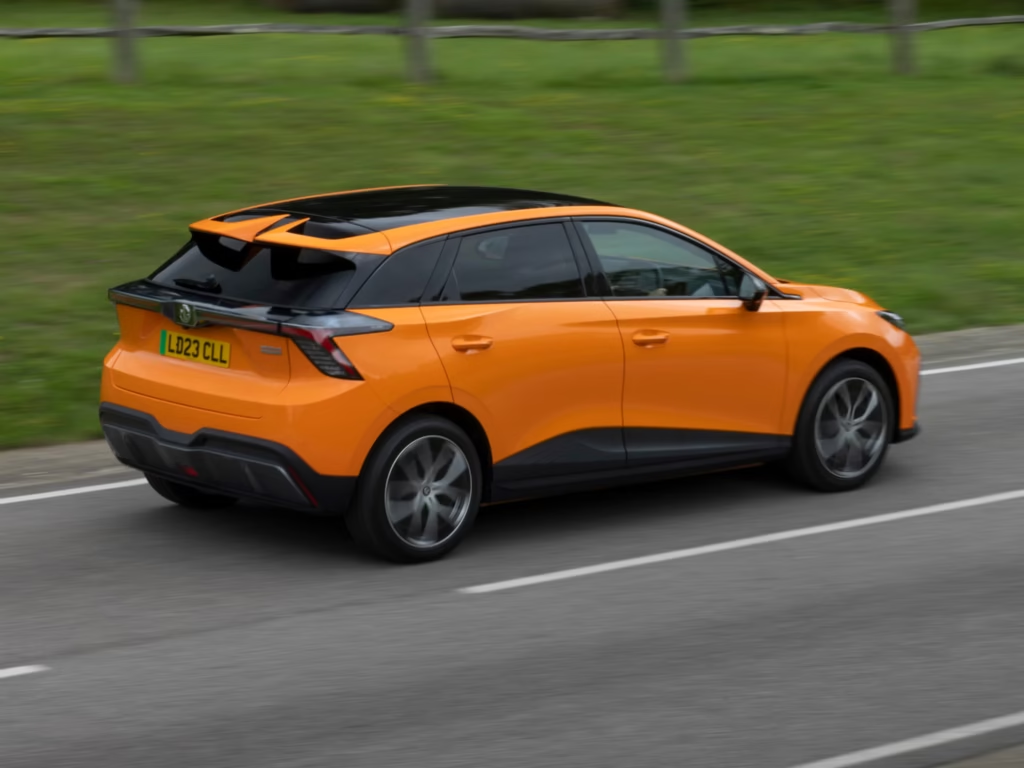
This is the car we recommend for most European buyers who are entering the Chinese EV market for the first time. The MG4 Long Range combines 450 km of WLTP range, 154 kW DC charging (the fastest of any car in this guide below €45,000), a five-star Euro NCAP rating, rear-wheel drive, and a seven-year warranty, all from €32,990. The 154 kW charging speed is the specification that most reviews underweight: at a motorway rapid charger, it adds around 160 km of range in 15 minutes. That is not Xpeng G6 territory, but it is genuinely fast by the standards most European buyers will encounter in their actual charging lives.
MG’s European dealer network is the most established of any Chinese brand, which matters for warranty work, parts supply and the day-to-day peace of mind of knowing where to take the car. The rear-wheel-drive configuration also makes the MG4 the most rewarding to drive of any car in this price bracket. Its weaknesses are real: the interior materials are a grade below those of the Leapmotor B10 in certain areas, and the original model’s touch-sensitive climate controls were replaced with physical buttons only in the 2026 facelift. Buyers should check which version they are looking at.
Buy if: You want the best combination of range, charging speed, driving dynamics and dealer support under €35,000.
Skip if: You need an SUV body style, the MG4’s hatchback form is not right for your needs.
Best Tesla Model 3 alternative: BYD Seal

The BYD Seal is BYD’s most direct answer to the Tesla Model 3, and the comparison holds up well on paper. The Seal’s long-range version offers 570 km of WLTP range against the Model 3’s 629 km, undercuts it by roughly €5,000 at equivalent trim levels, and scored identically (five stars, 87% adult occupant) at Euro NCAP 2023. The BYD Seal goes further on the battery argument: its Blade Battery uses LFP chemistry, which tolerates regular 100% charging without the degradation concerns associated with the Model 3’s NMC cells. Real-world data from fleet operators in Norway and Australia suggests that BYD’s LFP batteries retain more than 95% of their capacity at 100,000 km.
The Seal is not a perfect car. Its 150 kW DC charging matches the Model 3 Long Range but is well behind the Xpeng G6’s 451 kW ceiling. Its infotainment system is functional and stable, but lacks Tesla’s software update frequency and app ecosystem depth. The interior styling, with its rotating central screen and layered dashboard, is distinctive rather than premium. Buyers who want the cleanest, most minimalist cabin experience will prefer the Model 3. Buyers who want better battery longevity evidence and a lower price will prefer the Seal.
Buy if: You have been considering a Model 3 but want a lower price and prefer LFP battery chemistry.
Skip if: Software ecosystem depth and charging network integration matter most to you.
Best fast-charging SUV: Xpeng G6

The Xpeng G6 features a specification with no parallel in the European market at its price: a peak DC charging rate of up to 451 kW, delivering a 10-to-80% charge in approximately 12 minutes when connected to a compatible ultra-high-power charger. Most public rapid chargers in Europe currently cannot deliver that output, meaning most G6 owners will not experience peak charging speeds in daily use. But the practical real-world charging speed, even at a standard 150-175 kW charger, remains among the best in its class, because the 800V architecture delivers faster charging than Western cars across a broader range of charger types.
Xpeng officially launched in the UK in early 2026 with a version of the G6 that it says received over 20,000 engineering tweaks for British roads, covering suspension calibration, lane-keeping sensitivity, and driver-assistance behaviour. European prices start from €44,990 in the Netherlands. The G6 earns a five-star Euro NCAP rating, and its ADAS system has received strong marks in independent assessments. Its weaknesses are acknowledged even in Xpeng’s own press materials: the exterior design is restrained to the point of anonymity, and the infotainment system, while capable, falls short of the responsiveness of the best Korean and European rivals.
Buy if: Ultra-fast charging is a genuine priority, you regularly drive long distances, and software-first driving appeals.
Skip if: Design presence and interior premium matter most, or your local charging infrastructure is limited to 50-100 kW.
Best premium option with a different ownership model: Nio ET5 Touring

Nio occupies a different part of the European market from every other brand on this list. Its cars are premium, priced from €44,900 for the ET5 Touring, and built to specifications that compare favourably with BMWs and Audis rather than with MGs or BYDs. The ET5 Touring earned a five-star Euro NCAP rating and offers a WLTP range of 560 km. What makes Nio genuinely distinctive is its Battery-as-a-Service model: instead of waiting at a charger, owners at Nio swap stations can exchange a depleted battery for a fully charged one in under five minutes. As of May 2026, Nio operates swap stations in Norway, Germany, the Netherlands, Denmark, Hungary and Sweden. The network is growing, but it is not yet pan-European, and its utility depends entirely on where you live and where you travel.
Nio’s BaaS pricing lets buyers purchase the car without the battery, reducing the purchase price significantly, and then pay a monthly subscription for battery access and unlimited swaps. This model meaningfully changes the ownership calculus for high-mileage drivers who cannot charge at home. It is also the only approach in the European market that genuinely resolves the motorway charging time problem, rather than simply reducing it. The catch is that Nio’s service network outside its established markets is thin, and the premium pricing makes it a less compelling option for buyers primarily motivated by value.
Buy if: You drive long distances regularly, cannot always charge at home, and live near Nio’s swap station network.
Skip if: You are price-sensitive, or you live in a country where Nio’s swap network is not yet established.
Best for performance: Zeekr 7X

The Zeekr 7X is the most technically ambitious car on this list. Its 2026 model year update introduces a 900V architecture on the long-range variants, enabling a 10-to-80% charge in 10 minutes. The AWD Performance version produces 795 hp and reaches 100 km/h in 2.98 seconds. It holds the record for the highest overall score in the Small Family Car class at Euro NCAP 2024, where the standard Zeekr X version was named Best in Class. Its LiDAR-equipped Haohan 2.0 ADAS system supports urban driving and highway autonomy. Pricing in Europe starts from approximately €45,000, depending on the market, with the AWD version adding significantly to that.
Zeekr is a brand most European buyers have not encountered. It is the premium performance arm of Geely, one of China’s most respected automotive groups. The dealer network in Europe is limited to a handful of countries: the Netherlands, Sweden, Norway, Denmark, Germany, Belgium and the UK. Outside those markets, it is not currently available through official channels. The lack of Euro NCAP data for the 7X specifically (as opposed to the closely related 7GT and X, which are rated) is a genuine gap, though the platform’s engineering credentials are not in doubt.
Buy if: Performance, ultra-fast charging and technology leadership are your priorities, and you live in a Zeekr-served market.
Skip if: You live outside Zeekr’s current European coverage area, or dealer proximity matters for your ownership confidence.
Three Questions Before You Buy Chinese EVs in Europe
Where do you charge?
If you charge at home overnight, the DC charging speed is almost irrelevant for 80% of your driving. In that scenario, the Leapmotor B10, BYD Dolphin Surf, MG4 Urban and BYD Atto 2 all make strong cases despite their slower charging ceilings. If you charge primarily at public chargers, the MG4 Long Range (154 kW) and Xpeng G6 (up to 451 kW) are the cars that will make your charging stops meaningfully shorter. The Nio ET5 Touring with a swap station nearby is the only option that effectively eliminates the charging stop altogether.
How does Euro NCAP matter to you?
Several cars on this list have not been independently tested by Euro NCAP: the Leapmotor T03, BYD Dolphin Surf, BYD Atto 2 and Zeekr 7X. This does not mean they are unsafe. It means that the independent verification that European safety regulators and most car insurers use to assess a car has not yet been applied to these specific models. For buyers who place significant weight on that assurance, the MG4, MG4 Long Range, Leapmotor B10 (2025 test), BYD Seal, BYD Atto 3 Evo, Xpeng G6, BYD Sealion 7 and Nio ET5 all have published results.
How important is the dealer network?
MG has over 150 service points across Europe, and Leapmotor distributes through Stellantis’s network of Peugeot, Citroën and Vauxhall dealers. Both offer after-sales support comparable to that of mainstream European brands. BYD is rapidly expanding its network, but coverage outside major cities remains patchy in many markets. Xpeng, Zeekr and Nio are concentrated in specific countries and have thin coverage elsewhere. Before committing to any brand with a smaller network, check whether an approved service centre is within a practical distance from your home.
Editor’s Take
The car that deserves more attention than it gets from European buyers is the Leapmotor B10. It is not the most exciting car in this guide. Top Gear’s reviewer compared it to a Vauxhall Mokka, which is not exactly high praise. But the B10 demonstrates something important: a Chinese manufacturer offering a family SUV with genuine rear-seat space, a full standard-equipment list including heat pump and ventilated seats, five-star Euro NCAP certification, and Stellantis dealer access, for €29,900. That price point forces every European rival to justify its premium, and most cannot do so convincingly.
The car that is most overhyped relative to real-world usefulness is the Xpeng G6’s 451 kW peak charging speed. The specification is real, and it is genuinely impressive engineering. But most European buyers will never experience it because most European chargers cannot deliver that output. The G6 is still one of the better cars in the guide; its 800V architecture delivers real-world advantages even at standard rapid charger speeds, and its ADAS system is strong. Just do not buy it for the headline charging number without checking the charging infrastructure near where you live and travel.
For the majority of European buyers considering a Chinese EV for the first time, and wanting a single recommendation: the MG4 Long Range at €32,990. Seven-year warranty. Five stars. 154 kW charging. 450 km range. Established service network. Rear-wheel drive. It is the most complete package in its price bracket from any manufacturer, not just any Chinese manufacturer. Prices are correct at the time of publication and may change. Always verify with the manufacturer or dealer before purchase.
All 12 Models at a Glance
Chinese EVs available in Europe, May 2026
| Model | From (approx.) | WLTP range | Peak DC charge | Euro NCAP | Best for |
| Leapmotor T03 | €15,000 | 265 km | 45 kW | Not rated | City driving |
| BYD Dolphin Surf | €18,990 | ~260 km | 60 kW | Not yet tested | Premium |
| MG4 Urban | €25,990 | 323 km | 88 kW | 5 stars | Budget hatchback |
| Leapmotor B10 | €29,900 | 420 km | 80 kW | 5 stars (2025) | Family SUV value |
| MG4 Long Range ★ | €32,990 | 450 km | 154 kW | 5 stars | Best all-rounder |
| BYD Atto 2 | ~€29,000 | ~320 km | 88 kW | Not yet tested | Affordable SUV |
| BYD Seal | €40,990 | 570 km | 150 kW | 5 stars | Model 3 alternative |
| BYD Atto 3 Evo | €37,990 | ~480 km | 220 kW | 5 stars | Fast-charging SUV |
| Xpeng G6 | €44,990 | 525 km | Up to 451 kW | 5 stars | Tech / fast charging |
| BYD Sealion 7 | €49,990 | 500 km | 150 kW | 5 stars | Large family SUV |
| Zeekr 7X | €45,000+ | 615 km | Up to 400 kW | Not yet tested | Performance |
| Nio ET5 Touring | €44,900 | 560 km | ~150 kW | 5 stars | Battery swap option |
★ = JustChinaCars.com top pick for most European buyers. WLTP figures are official and overstate real-world range by 15-25%. DC charging figures are peak rates; actual speeds depend on the charger and battery temperature. European prices vary by country. Sources: manufacturer websites, ecarstrade.com, electriccarscheme.com, T3, May 2026.

Dollars loves following the latest innovations in automobile technology and sharing insights.
When she’s not writing, you can find her playing badminton or diving into a new opera piece.