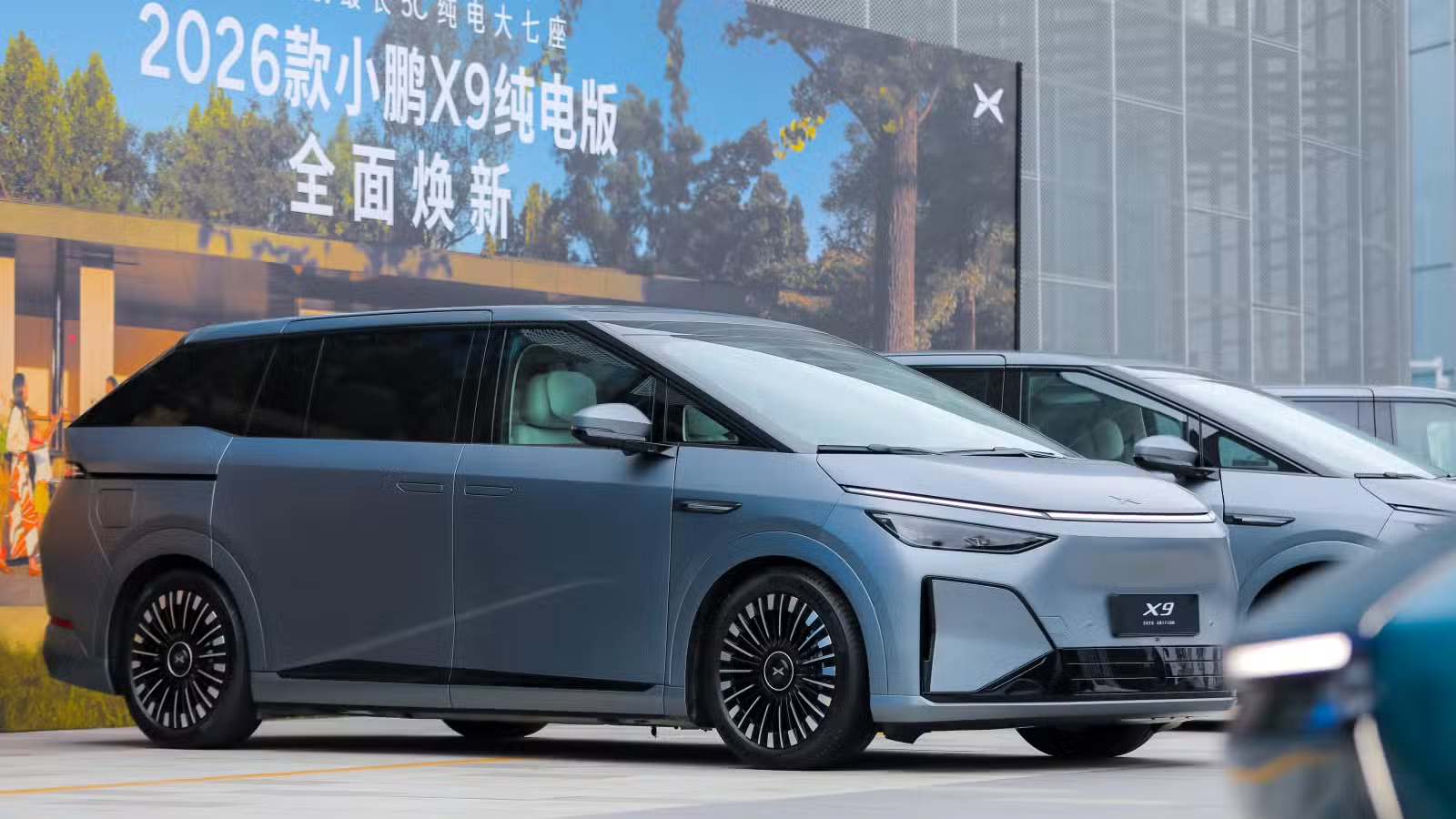
Xpeng launched the third-generation X9 BEV on March 2nd, cutting the entry price by 50,000 yuan, a 14 percent reduction ,to 309,800 yuan (approximately $45,200). Every variant of the new X9 comes fitted as standard with Xpeng’s Turing AI chip and the second-generation Vision-Language-Action model, known asVLA 2.0, the company’s most advanced autonomous driving system to date. The same system is being adopted by Volkswagen as its first commercial AI driving software customer, the first time a major Western automaker has chosen Chinese-developed autonomous driving technology.
The 2026 X9 is Xpeng’s flagship full-size electric MPV, competing in a premium segment that includes the Li Auto MEGA and the Denza D9. The third generation extends the car’s maximum CLTC range to 750 km, a figure Xpeng claims makes it the world’s longest-range pure-electric seven-seater supporting 5C fast charging. Five variants are available, priced between 309,800 and 369,800 yuan. An extended-range version, the X9 EREV 1602 Ultra SE, is separately priced at 321,800 yuan. Deliveries are expected to begin in China this month, with VLA 2.0 rolling out via OTA to Ultra trim vehicles in late March, followed by remaining trims in April.
2026 XPENG X9 BEV AT A GLANCE
| Specification | 2026 Xpeng X9 BEV |
| On sale | March 2026 (China). International delivery targeted 2027 |
| Price (from) | 309,800 yuan (~$45,200) — five variants to 369,800 yuan (~$53,900) |
| Powertrain options | Single-motor FWD (235 kW) or dual-motor AWD (370 kW combined) |
| Platform | 800V high-voltage — 5C ultra-fast charging as standard |
| CLTC range | 650 / 665 / 710 / 750 km depending on variant |
| Charging (5C DC) | Recovers 400 km of range in 8 minutes |
| Energy consumption | 15.9 kWh/100 km (CLTC) |
| AI chip | Xpeng Turing — up to 2,250 TOPS (3 chips on top variant) |
| Driver assist | VLA 2.0 — standard across all trims (OTA rollout late March) |
| Dimensions (LxWxH) | 5,293 x 1,988 x 1,785 mm — wheelbase 3,160 mm |
| Suspension | Dual-chamber air suspension with rear-wheel steering |
| Seating | 7 seats — three-row electric folding zero-gravity function |
| Rivals | Li Auto MEGA, Denza D9, Toyota Alphard |
What Changed from the Previous Generation

The most consequential upgrade on the 2026 X9 is one that buyers will notice every time they stop to charge. On the 2025 generation, only the entry-level variant supported 5C fast charging; the remaining trims were capped at 3C, meaning a 10–80% charge took 20 minutes.
The 2026 model upgrades every variant to 5C as standard, cutting that time to 11.7 minutes. Both battery packs have also grown: the smaller unit moves from 94.8 kWh to 110 kWh, and the larger from 105 kWh to 110 kWh, a standardisation that simplifies the range and pushes maximum CLTC range from 740 km to 750 km across the lineup.


The driver assistance system is a complete generational step. The 2025 X9 ran Xpeng’s first-generation VLA model on the Turing chip, which was itself a significant improvement over the XNGP system it replaced. The 2026 model moves to VLA 2.0, with inference speed Xpeng claims is 12 times faster and average driver takeover distance on complex roads improved by a factor of 13. Critically, VLA 2.0 is now fitted as standard across all five variants, not just the top trim. The 2025 generation required buyers to choose the higher trim levels to access the full ADAS capability.

The exterior changes are minor but deliberate. The front surround adopts a concave shape matching the EREV version, with hidden longitudinal ventilation openings and a central active grille heat-dissipation opening. The three-stage LED through-light cluster has been sharpened, and the overall length increases by 23 mm to 5,316 mm due to corrections to the surround kit, not a structural change. The 2025 model’s two-bumper-mounted LiDAR units are gone, replaced by the camera-based Hawk Eye ADAS system first seen on the P7+, a weight and cost reduction that Xpeng argues is justified by VLA 2.0’s reduced dependence on LiDAR input.
Inside The Xpeng X9 MPV

Inside, the 2026 X9 introduces the AI Dimensity 6.0 intelligent cockpit, replacing the previous generation’s system with one that supports active services, intelligent welcome, charging recommendations and an OMS cockpit care system. Zero-gravity seats now include leg rest heating and the world’s first three-row electric folding function, an upgrade over the 2025 model’s manual third-row folding.


The lower air conditioning vent area has been redesigned, and three new interior colour options replace the previous palette. Carry-over highlights include the 21.4-inch second-row entertainment screens, 23-speaker 2,180W XOpera audio system, dual-chamber air suspension with rear-wheel steering, and the 0.227 Cd drag coefficient that remains class-leading for a vehicle of this size.
Xpeng X9 MPV
The X9 was Xpeng’s first MPV, launched in January 2024 as a pure-electric model. A second generation followed in April 2025, priced from 359,800 yuan. In November 2025, Xpeng added an extended-range variant, a strategic move to address Chinese buyers’ anxieties about pure-electric range in a segment used primarily for long-distance family travel.
The X9 delivered 26,017 units throughout 2025, accounting for just over six percent of Xpeng’s total deliveries for the year. That is a modest number for a flagship model, and the price cut on this third generation is a direct response to intensifying competition in the premium MPV segment.


The Volkswagen relationship provides critical context for understanding this launch’s significance beyond the car itself. Volkswagen invested $700 million in Xpeng in July 2023, acquiring a 4.99 percent stake and commissioning two jointly developed EVs. That partnership has expanded steadily since, into platform collaboration, shared electronic architecture, and now AI software. Xpeng’s CEO He Xiaopeng confirmed on February 26th that Volkswagen will serve as the launch customer for VLA 2.0, describing it as a pivotal moment: the first time a leading global automaker has chosen to build on Chinese AI driving technology rather than develop its own.
VLA 2.0 is technically distinct from most driver assistance systems currently in production. Unlike conventional vision-language-action architectures that rely on language translation as an intermediate step, Xpeng’s implementation bypasses language translation entirely, delivering direct end-to-end output from visual input to driving action. Xpeng claims the system’s inference speed is 12 times faster than the previous generation, and that it increases average driver takeover distance on complex roads by 13 times versus the outgoing system. Morgan Stanley, which maintained an Overweight rating on Xpeng following the launch, called VLA 2.0 a bold leap forward and set a price target of $34, representing approximately 94 percent upside from current levels.
What This Means
For buyers considering the X9, the price cut is meaningful. At 309,800 yuan, the entry variant now matches the EREV version launched just four months ago, and the Li Auto MEGA, its most direct rival, starts at a broadly comparable price point.
Buyers who previously found the X9 expensive relative to its competition now have less justification to look elsewhere, particularly given the 750 km CLTC range claim and 5C charging across all trims. The 8-minute 400 km charge recovery figure, if it holds in real-world conditions, addresses one of the last meaningful arguments for choosing an EREV over a pure-electric vehicle in this segment.
For the industry, the Volkswagen VLA 2.0 deal is the bigger story. This is not a manufacturing partnership or a vehicle co-development agreement, it is a German automaker adopting Chinese AI software for its own vehicles.
That is a significant inversion of the technology flow that has defined the automotive industry’s relationship with China for four decades. Whether Volkswagen deploys VLA 2.0 in China-specific models or more widely remains to be confirmed, but the signal it sends is unmistakable: Chinese autonomous driving technology has reached a level of maturity that established Western automakers are willing to build on rather than compete with.

The timing of this launch also needs context. Xpeng reported February deliveries of 15,256 units, down nearly 50 percent year-on-year. Though the company and industry observers have attributed much of that decline to the extended Chinese New Year holiday period, which left only 16 working days in the month. Xpeng has set a 2026 delivery target of 550,000 to 600,000 vehicles, representing up to 40 percent growth on 2025’s 429,400 units. The X9 relaunch, the VLA 2.0 reveal, and four new SUV models planned for 2026 are all part of a deliberate push to sustain that trajectory through the year.
For readers outside China: the 2026 X9 is currently a China-only launch. Xpeng has confirmed international delivery targeted for 2027, with the Mona series planned for European introduction this year as the nearer-term export priority. Buyers in Europe or Australia considering Xpeng should watch the international specification and pricing announcement closely — the X9 at these specifications and price points would represent a genuinely compelling proposition in any market where it lands.
Editorial Take
The 2026 X9 is a solid if incremental product update with longer range, same strong interior, and better software. The price cut is welcome and positions it more aggressively against the Li Auto MEGA. But the car itself is not the story here. The story is that Volkswagen has chosen to deploy Xpeng’s AI rather than build its own, and that deserves more attention than it has received.
Think about what that decision represents. Volkswagen spent the better part of a decade and billions of euros trying to build a credible software-defined vehicle business. It launched Cariad, its in-house software division, in 2020 with enormous ambitions. Those ambitions ran into well-documented execution problems. Delays, cost overruns, the departure of senior leadership. Meanwhile Xpeng, a company that did not exist until 2014, has built an autonomous driving system that a 90-year-old German automotive institution is now willing to license for its own products. That is a signal about where the centre of gravity in automotive technology has shifted.
Whether VLA 2.0 delivers on its performance claims in the real world remains to be seen. Xpeng’s internal metrics and Morgan Stanley’s enthusiasm are encouraging, but autonomous driving has a long history of promises that proved harder to keep on public roads than on test tracks. The coming months, as VLA 2.0 rolls out via OTA and enters daily use, will tell us more than any launch event could.
Sources: CnevPost, electric-vehicles, Autohome

Dollars loves following the latest innovations in automobile technology and sharing insights.
When she’s not writing, you can find her playing badminton or diving into a new opera piece.